




and the other for high dose applications in Navi Mumbai. Given the
success of these two plants, several governmental agencies and entrepreneurs
are showing interest in setting up similar plants in the country.
|
Radiation processing plant, Navi Mumbai,
Maharashtra
|
|
KRUSHAK, (Krushi Utpadan Sanrakshan
Kendra)
Lasalgaon, district Nashik, Maharashtra |
Board of Radiation and Isotope Technology (BRIT) has signed memoranda
of understanding with 12 entrepreneurs for setting up radiation
processing plants and one is ready for commissioning shortly. The
Department has to gear up to ensure continued supply of radiation
sources for these plants. These could be 60Co or 137Cs. BARC should
set up facilities for the recovery of 137Cs from radioactive waste11
. In the interim, production of 60Co from PHWRs may be stepped up.
PHWR of 700 MWe rating being designed by NPCIL should be designed
to facilitate handling of 60Co with minimum man-rem expenditure.
Radiation processing can be done using gamma rays or electron beams
or X rays from machines. Machine based plants could be even mobile.
In addition to radioisotope based sources, machine sources need
to be developed and deployed. For large-scale deployment, monitoring
and regulatory aspects have to be given due importance. Towards
this end, there is a need for developing on-line methods for detection
of irradiated foods. Product associated materials like sand particles
could be useful for dosimetry.
| 11 For related discussion, see sub-topic
‘fuel cycle’. |
Development of alternative methods of food grain preservation such
as vacuum storage were also proposed.
R&D activities using radiation technology in combination with
appropriate packaging and existing and emerging methods of food
preservation (hurdles) will be undertaken. With the shift in consumer
preference towards ambient stable and fresh ‘nature like’
foods, focus will shift towards secondary products, minimally processed,
ready-to-eat and ready-to-cook convenience foods and traditional
ethnic food. Other products with export potential are cut flowers
and vegetables and medicinal plants. Radiation processing can also
be harnessed to improve certain properties such as colour, aroma
and flavour of food ingredients. Degradation of biopolymers by radiation
could facilitate their improved amenability to microbial fermentation,
which could be utilized for the conversion of food waste to value
added products such as organic acids, flavourants, bioactive compounds
etc.
Following the approval of the radiation processing as a quarantine
measure, irradiation facilities will be required for import as well
as export of agricultural commodities. The scale up of the new processes
and regulatory approval from the government agencies for the new
processes would facilitate their commercialization.
Environment and Health
Environmental impact assessment is routinely carried out before
any nuclear facility is set up. The need for such an assessment
will grow as the programme expands and therefore, the methodologies
and mechanisms for assessment would need strengthening. There was
a suggestion for setting up a task force for evolving an improved
risk assessment methodology.
An essential component of the risk assessment programme will be
monitoring of the radioactive and conventional pollutants around
the areas of interest and studying their migration processes and
pathways into the ecosystem. Enhancement of the efficiency of the
entire process requires development of new monitoring techniques
like optical and biological indicators of contaminants in water
and food stuff, micro-sensors using MEMS technology, resonance ion
mass spectrometry techniques for ultra trace level measurements
of actinides etc. Pollution mitigation technologies based on accelerators
and non-thermal plasma techniques will have to be utilized.
|
Indian environmental radiation monitoring
network (IREMON)
|
Development of improved phosphors and monitoring systems for the
dose assessment of personnel was proposed. In the studies connected
with reactor safety assessments, the existing nuclear aerosol test
facility at BARC can be used for future containment related experiments
and for validation of the presently used reactor safety codes. The
development of models for atmospheric dispersion of species related
to the front end of the nuclear fuel cycle and to predict accidental
releases needs urgent attention.
Risk assessment of human populations residing around nuclear facilities
may be achieved by two approaches. The first approach involves carrying
out projective risk estimation after obtaining the inventory of
chemical pollutants and the nuclear discharges, and pathway analysis
to compile the transfer factors. Using UNSCEAR and USEPA based risk
coefficients and standard risk models, the projected risks to the
humans can be assessed. The second approach involves direct risk
assessment from epidemiological studies of the populations residing
around DAE facilities. The data on the socio-economic factors as
well as the health records of the subjects under study need to be
collected along with the dose data of the DAE occupational workers.
These, along with similar data on the populations living in high
background radiation areas12 and the industrial radiographers, can
be pooled together to estimate low dose risk coefficients. New cancer
registries (in collaboration with ICMR) need to be set up around
the regions of interest. The R&D component of programme would
comprise the radiobiological studies associated with human bio-monitoring,
studying the low dose effects etc.
The use of radioisotopes and nuclear medicine will present new
vistas in veterinary care and reproduction. This will help in improving
quality of meat as well as developing models for human applications.
For in vivo imaging in animals it will be useful to add facilities
like gamma camera, animal PET/CT and phosphor imager. Newer PET
radiopharmaceuticals using 18F and 11C have a good potential for
diagnosis of several diseases including brain disorders. Development
of therapeutic agents using cyclotron produced radioisotopes like
103Pd and 114mIn/114In for targeted therapies for cancer and 117Lu-DOTMP
for bone pain palliation is envisaged. Development of proton beam
therapy and 90Sr- 90Y generators and 137Cs based brachytherapy needs
to be undertaken.
| 12 See the sub-topic ‘biological
sciences’, for more discussion on studies related to high
background radiation areas. |
Among the non-radioisotopic medical technologies, optical techniques
for biomedical imaging and diagnosis are proving to be very useful
non-invasive methods. Considering the very encouraging results already
obtained, R&D in this area needs to be augmented and deployment
of such systems should be taken up. Non-linear dynamical methods13
can be applied to get a better understanding of cardiac arrhythmia,
cancer and various neurological disorders. Cortical prosthesis for
the blind, artificial limb for the handicapped and a closed loop
control system for monitoring patients under critical care can be
developed using the expertise in electronics and robotics. Lastly,
DNA and multi-analyte protein micro-arrays could be developed for
diagnosis of tuberculosis.
Water
About 70% of the earth’s surface is covered with water. Only
0.3% of total water on earth is fresh water. Today, India is amongst
the water stressed countries (with a deficit of 25%) and by the
year 2025, will be amongst the water scarce countries (water availability
1340 m3/person-year; with a deficit of 33%). This is an average
figure, but for a large fraction of Indian population, water scarcity
is already a reality. Therefore, to ensure a secure future, it is
necessary to improve water availability by integrated water resource
management, which includes the following.
1. Conservation of water
2. Rain water harvesting
3. Water recovery and recycle
4. Removal of contaminants
5. Augmentation of water availability with large size desalination
plants
|
Nuclear desalination demonstration
plant (NDDP) at Kalpakkam |
Being a storehouse of technologies, DAE has expertise in many of
the above-mentioned areas and with some minor modifications, the
available technologies can be adapted for local conditions. India
has a 7000 km long coast and along this coastal line, the ocean
can be an inexhaustible source of water supply, if only sea water
can be converted into salt free water. This can be done through
desalination technologies. BARC has expertise in various thermal
desalination technologies that include multi-stage flash (MSF),
multi effect desalination (MED), low temperature evaporation (LTE),
hybrid concepts etc. and has offered this expertise for commercial
use to various interested agencies by signing appropriate agreements.
BARC also has expertise in various membrane based desalination technologies
like reverse osmosis (RO), nano-filtration (NF), ultra-filtration
(UF) etc., and has transferred RO technologies to various agencies
for commercial use. We have also set up nuclear desalination plants,
one at Kalpakkam and the other at Trombay. Nuclear desalination
demonstration plant (NDDP) at Kalpakkam is coupled to the Madras
Atomic Power Station and the Trombay plant is coupled to the research
reactor CIRUS. Whereas the water from the NDDP is being used for
potable purposes, the water from the plant at Trombay is meeting
the de-mineralized water requirement of the research reactor CIRUS
| 13 See the sub-topic ‘biological
sciences’, for more discussion on studies related to high
background radiation areas. |
|
Low temperature evaporation desalination
plant at research reactor CIRUS |
BARC should establish large-sized desalination plants coupled to
each of the nuclear power plants located at coastal sites. In coastal
areas, where nuclear power is not available, conventional fossil/gas
based power plants can be used to supply energy. These plants can
either use live steam from power plants or utilize the low grade/waste
heat from various sources like waste heat from the moderator system
of PHWR, waste heat of nuclear research reactors and other process
industries.
Wherever adequate power is available, large size reverse osmosis
plants can be established to cater to the water requirements of
the public and other sectors.
Integrated water management including conservation of water resources,
rain water harvesting, recycle of wastewater and purification of
contaminated water can solve water problem to a large extent. Isotope
techniques in hydrology can be used for water resource development
and management. These can be used for estimating submarine ground
water resources and recharge of aquifers. Use of new isotopes e.g.,
15N & 18O (NO3-), 34S & 18O (SO42-), 11B, 36Cl, 37Cl, 3H/4He,
222Rn, 226Ra, will give additional information in the area of inter-aquifer
interrelations, ground water salinization mechanism as well as sources
and mechanism of ground water pollution by arsenic, nitrate and
fluoride, sites for rain water harvesting. The new techniques can
also generate baseline isotope data for national river interlinking
programme and to identify the leakage sites in dams and lakes etc.
|
Filter developed by licensees based
on BARC technology |
R&D efforts should continue towards development of the following.
1. Tailor made membranes for radioactive effluents treatment and
for removal of specific contaminants.
2. Membrane technology for making water available for domestic use
from brackish water and recovery & recycle of household waste
water similar to the success story of on-line domestic water purifier.
3. The new technology of carbon aero-gel based capacitive de-ionization
which can be used on small as well as large scale to produce potable
as well as industrial grade water.
4. In coastal villages, wind based and solar energy based desalination
systems can be explored in association with appropriate agencies.
5. Technology for use of ocean thermal energy gradient (OTEG) for
desalination in association with appropriate agencies.
Urban and Rural Waste management
Urban waste includes solid, liquid and gaseous matter generated
from homes, industries, public utilities such as hospitals, automobiles
etc. These wastes, when not disposed properly, result in the deterioration
of the environment resulting in health hazard and disturb ecological
balance. The conventional methods like incineration of solid wastes
are undesirable due to poor performance and toxic emissions. Plastics,
which have become a primary component in the urban waste, are not
biodegradable and cannot be disposed off by incineration due to
the formation of toxic gaseous compounds.
|
Nisargaruna plant at Trombay |
The biodegradable wastes, if left unattended, pose health hazards.
There is a need for an integrated approach for handling enormous
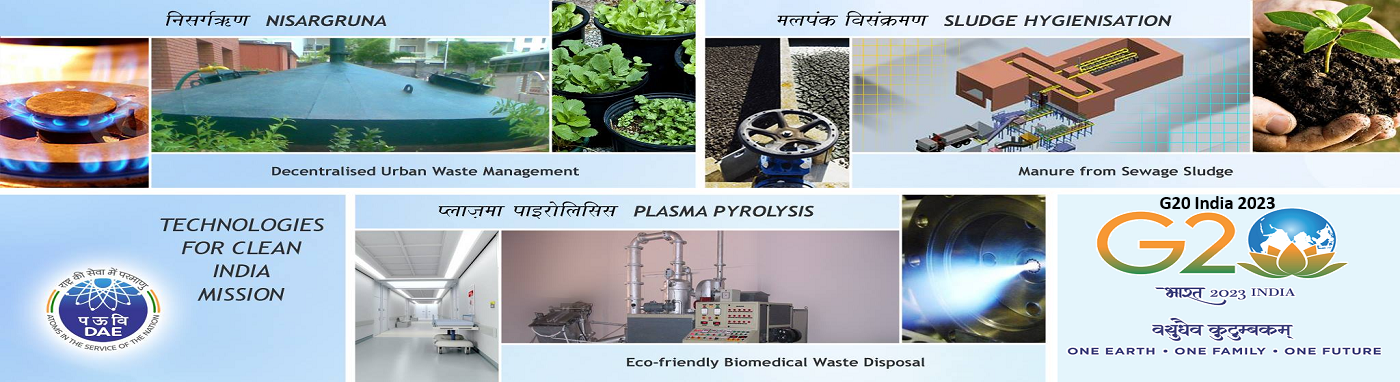
amount of waste generated everyday. Nisargaruna, an ongoing project
in DAE utilizes the biodegradable wastes to generate energy as well
as organic manure. The variety of biodegradable waste as well as
variation in weather conditions in different parts of the country
present a challenge to its widespread deployment. In recent times,
Nisargaruna type biogas plants have been installed at 6 places and
agreements have been signed for a few more in Thane and other places.
One of the important requirements of this plant is the user for
the methane gas produced. Efforts are now on to improve the design
of the plant with respect to the mixer, enhanced capacity, sensors
for temperature, oxygen, carbon dioxide, pH etc. To make this technology
versatile, there is also a need to isolate and maintain the microbial
consortia that would be suitable for different types of waste.
|
Sludge hygienization research irradiator
(SHRI) facility at, Vadodara, Gujarat |
Municipal sewage is another major concern in waste disposal as
it contains several pathogenic organisms in addition to heavy metals,
useful micronutrients etc. Gamma irradiation can be used to decontaminate
sewage sludge and the sludge so treated can be used as a soil conditioner
with or without value addition as has been shown by the experience
of operating the sludge hygienization research irradiator (SHRI),
Vadodara. Deployment of this technology in several metropolitan
and larger cities is the need of the hour. The possibility of converting
the present sewage treatment plants (STPs) to SHRI type plants needs
to be pursued.
For treatment of liquid waste, industrial effluents and flue gases,
electron beam technology can be effectively deployed.
Pyrolysis is a process in which carbonaceous material is disintegrated
in the absence of oxygen into smaller fragments such as CO, H2,
and CH4 etc. Plasma can be used for attaining temperatures that
are highly suitable for pyrolysis.
|
| |
|
Pyrolysis plant at Institute for Plasma
Research |
One such system uses a
plasma torch technology developed and patented by the Institute
for Plasma Research (IPR). Commercial prototype pyrolysis units
for medical waste disposal are operational at two major hospitals
in the country and a truck-mounted model is also operational. Although
the technology is very competitive, it has not gained popularity,
as the plasma pyrolysis process is not included in the notification
issued by the pollution control board. It is desirable to get the
approval for inclusion of this technology under pollution control
act through a gazette notification. Further development activity
would include increasing the plasma torch power to 50 kW to increase
the handling capacity, to develop methods for liquid toxic waste
disposal and to design and develop large-scale systems. The setting
up of a state-of-the-art gas laboratory would help in carrying out
investigations on energy recovery from the process.
Another application of
the plasma is through atmospheric pressure glow discharge (APGD)
for the pollution abatement. A laboratory model has indicated considerable
dissociation of hexane, benzene and other petrochemical pollutants
and this system is operational at IPCL, Vadodara and there is an
increasing demand for these systems. The efforts would be towards
commercializing the APGD technology, development of a catalyst and
development of a high voltage compact power supply.
Overall, depending on
the type of waste, a location-specific management is called for.
Its advantage in indirect terms like savings in health care cost,
far outweighs the initial installation cost of the different types
of plants. |