



| Introduction
The Department of Atomic Energy was established
on August 3, 1954. The last 50 years have been very productive and
the Department has been able to establish a network of institutions
engaged in R&D as well as industrial activities and acquire
expertise in all aspects of the nuclear fuel cycle. The first stage
of the nuclear power programme is in commercial domain and the second
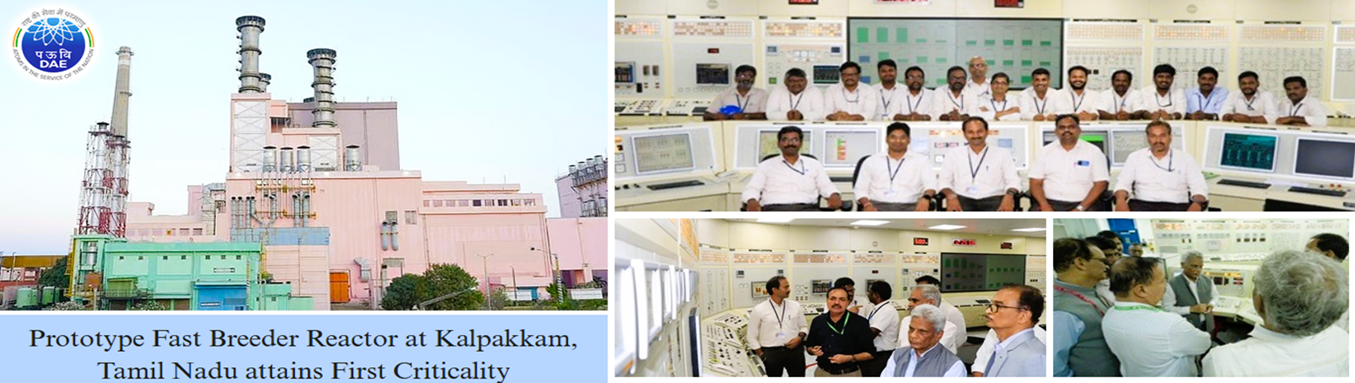
stage has been launched with the initiation of work on 500 MWe Prototype
Fast Breeder Reactor (PFBR). Work on the reactors to be launched
in the third stage is being pursued in right earnest. A wide range
of technologies have been developed to come to the present stage
of exploitation of nuclear energy and efforts are continuing to
develop technologies for the future. Technologies to be developed
for future applications include those necessary for building accelerator
driven sub-critical reactor system (ADS) and fusion technologies.
Several applications of radiation and isotope technologies for improving
the quality of life have been developed and deployed and efforts
on this front are also to be continued.
Both the research centres and the grant-in-aid institutions of
DAE carry out research and development. While the research centres
focus more sharply on technology and product development, the grant-in-aid
institutions concentrate relatively more on basic research. In the
process, the research centres and the grant-in-aid institutions
have provided high caliber technologists as well as scientists to
the Department, but for which India’s spectacular strides
in the field of nuclear sciences and their applications would not
have been possible. To further accelerate this process, the DAE
has submitted a proposal to the Ministry of Human Resource Development
to set up an Institute to be called ‘Homi Bhabha National
Institute, (HBNI)’ having the status of a deemed university1
.
The occasion of the golden jubilee year was considered as the appropriate
occasion for examining what the Department has achieved in the past
and to plan for the future. For this exercise, several satellite
meetings were organized and they culminated in a plenary vision
meeting during May 17-19, 2004 held at Bhabha Atomic Research Centre
(BARC). Wide-ranging discussions were held on various topics, which
were divided in the following categories.
Energy vision,
Societal vision,
Technological vision,
Directions for basic research and possible feedback into DAE programmes,
and
Human resource development.
| 1 More discussion about HBNI appears
under the topic ‘human resource development’. |
A similar vision exercise conducted in 1995 provided enough material
to the Department to shape the ninth five-year plan and the ongoing
tenth five-year plan. It is expected that the present vision exercise
will help in the formulation of the eleventh and subsequent five-year
plans.
This report summarizes the deliberations. The mandate of the Department
is to develop and deploy technologies for the production of nuclear
power and to harness applications of radiation and isotope technologies
for societal benefit. To fulfill this mandate, several technologies
need to be developed and it is necessary to carry out basic research
to provide a strong foundation to ongoing developments and to spur
new developments. To meet all these objectives, human resource development
is the most important. Thus all the topics listed earlier are interrelated.
Cross-references are provided to highlight certain specific interrelations.
|