






540 MWe Unit-3 of Tarapur Atomic Power Project Achieves Criticality.

Unit-3 of Tarapur Atomic Power Project (TAPP-3) attained its first criticality today, May 21, 2006. The achievement of criticality is a major milestone in the project completion process. It signifies the start of self-sustaining nuclear fission chain reaction in the reactor core. The criticality of Unit-3 comes about two months ahead of schedule. Last year Unit-4, the predecessor of Unit-3, achieved criticality on March 6, 2005.

The 540 MWe TAPP-3, a totally indigenous nuclear power unit, is the 16 th nuclear power reactor in the country. It has been designed and built by Nuclear Power Corporation of India Limited (NPCIL), a public sector undertaking under the Department of Atomic Energy (DAE). Many DAE units have provided valuable R&D and material inputs. Indian industry has played a major role in supply of critical equipment and in meeting highly crashed construction schedules.

Tarapur Atomic Power Project Units-3&4 (TAPP-3&4) comprises two Pressurised Heavy Water Reactor (PHWR) units of 540 MWe each. PHWRs use natural uranium fuel and heavy water both as moderator and coolant.

TAPP-3&4, India 's largest nuclear power plant has been built in the shortest time of any PHWR in India . This gestation period is comparable to international benchmarks.

All major milestones of TAPP-3 have been achieved ahead of schedule. TAPP-3 is scheduled to be synchronised with the Western-grid in June 2006, in less than half the time taken for TAPP-4.

The project is expected to be completed at a cost of Rs. 6100 crores though the TAPP-3&4 has an approved cost of Rs.6525 crores.

TAPP-3&4 will generate 1080 MWe of electricity which will be distributed to the beneficiary states.

It has been the combination of a dedicated team, modern methods of design and construction, adoption of higher levels of mechanisation and automation, improved planning and monitoring and pro-active management that has contributed to the success story of TAPP-3&4.

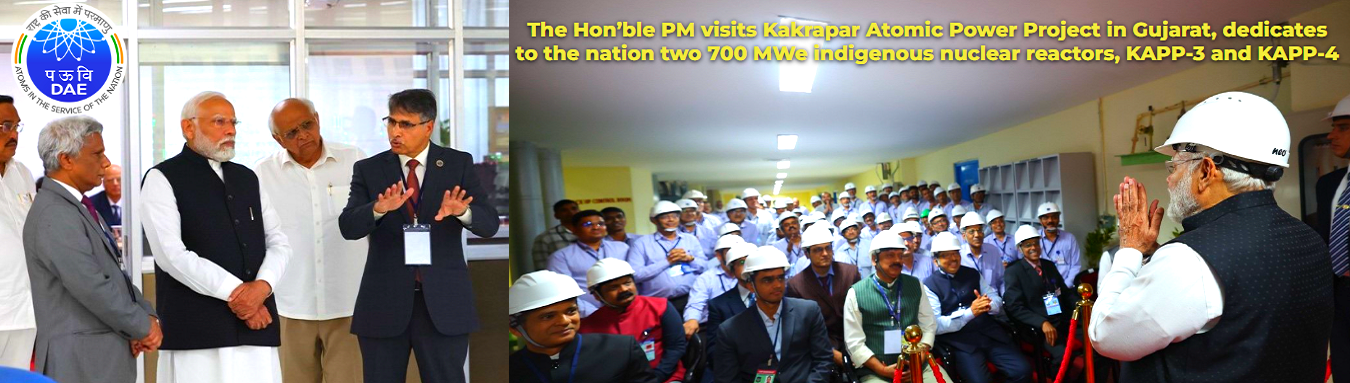
The experience gained in the design, construction and commissioning of the 540 MWe units is being effectively utilised for upgrading the unit size to 700 MWe. Four PHWR units, each of 700 MWe, are proposed to be set-up. Of these two will be at Kakrapar in Gujarat and the other two at Rawatbhata in Rajasthan.

NPCIL has plans to increase the installed nuclear power capacity. From the present 3360 MWe, the installed nuclear power capacity will increase to 4,120 MWe by end of 10 th Five Year Plan (2002-07) and 10,280 MWe by 11 th Five Year Plan (2007-2012). This is planned to be raised to 20,000 MWe by the year 2020.

NPCIL is unique in having comprehensive capability in the various facets of nuclear technology namely – site selection, design, construction, commissioning, operation, maintenance and life extension of nuclear power plants