



- Government of India
- Department of Atomic Energy
- Public Awareness Division
-
- No.
13(1)/2009/PAD-PR
December 01, 2009
-
-
- PRESS RELEASE No: 08/2009
-
- Department
of Atomic Energy in joint participation with the Indian
National Science Academy, the Indian Academy of Sciences, the National
Academy of Science (India) and the Royal Society, London is organising ‘Bhabha
Centenary Symposium: Science and Technology at the Frontiers’ during
December 3-5, 2009 to commemorate the birth centenary of Dr Homi Jehangir
Bhabha.
-
- The Symposium focuses on issues related to science,
society and culture, spanning a range of human activity from physics,
chemistry, mathematics and biology to nuclear energy, agriculture and
medicine to music, painting, history and cinema. It will highlight Bhabha’s
scientific contributions in various areas, the present status and future
of these areas and the wide-ranging involvement of the DAE, as well as
Bhabha’s commitment to India’s development and his refined sense of
aesthetics. It consists of invited talks by eminent scientists, thinkers
and cultural figures from India and abroad, as well as cultural programmes
representing both the Indian and Western performing arts.
-
- The Symposium is Chaired by Dr. Srikumar Banerjee, the
newly appointed Chairman, Atomic Energy Commission and Prof. Mustansir
Barma, Director, TIFR. Dr. Anil Kakodkar is the Patron. The Presidents of
the three Indian science academies and Sir Arnold Wolfendale on behalf of
the Royal Society, London, will deliver brief addresses.
-
- The Symposium will feature talks by Nobel Laureates Chen
Ning Yang and Carlo Rubbia, legendary for their theoretical and
experimental discoveries respectively that underpin our present
understanding of elementary particles and forces.
-
- Condensed-matter physics, chemistry and nanoscience will
be covered by famed materials chemist C.N.R. Rao, German physicist Knut
Urban, UK metallurgist W. Mark Rainforth, Indian-American Sunil Sinha and
Peter Littlewood, head of the Cavendish Laboratory at Cambridge. Speakers
in the area of nuclear science and technology include Claude Guet of the
French Atomic Energy Comissariat, R. Chidambaram, former AEC chairman and
present Principal Scientific Advisor to the Government of India, and
renowned agriculturist and parliamentarian M.S. Swaminathan.
-
- Noted physicist and policy-maker M.G.K. Menon, veteran
mathematician M.S. Narasimhan and senior biologist Obaid Siddiqi will
speak on their personal encounters with Homi Bhabha and his role in
nurturing different areas of Indian science. Seminars related to the space
sciences will be delivered by former Astronomer Royal Arnold Wolfendale
and former ISRO Chairman G. Madhavan Nair. US-based scientists with strong
Indian connections include Raju Raghavan, expert on neutrino detectors and
Ganapathi Rao Myneni who works on frontier technology for nuclear power.
Sergio Bertolucci, director of Research and Computing at CERN, will
review the status of the Large Hadron Collider. Vivek Datar, Shiraz
Minwalla and Vidita Vaidya are among the outstanding young researchers in
the DAE system.
-
- In tribute to Homi Bhabha’s multi-faceted personality,
film-maker Shyam Benegal and painter Krishen Khanna will cover the visual
arts. The Symposium will also feature a performance of the Symphony
Orchestra of India conducted by Zane Dalal, and a dance programme
performed by Dr Mallika Sarabhai and her Darpana Academy of Performing
Arts. Dr Sarabhai is the daughter of the late space scientist and
contemporary of Homi Bhabha, Dr Vikram Sarabhai.
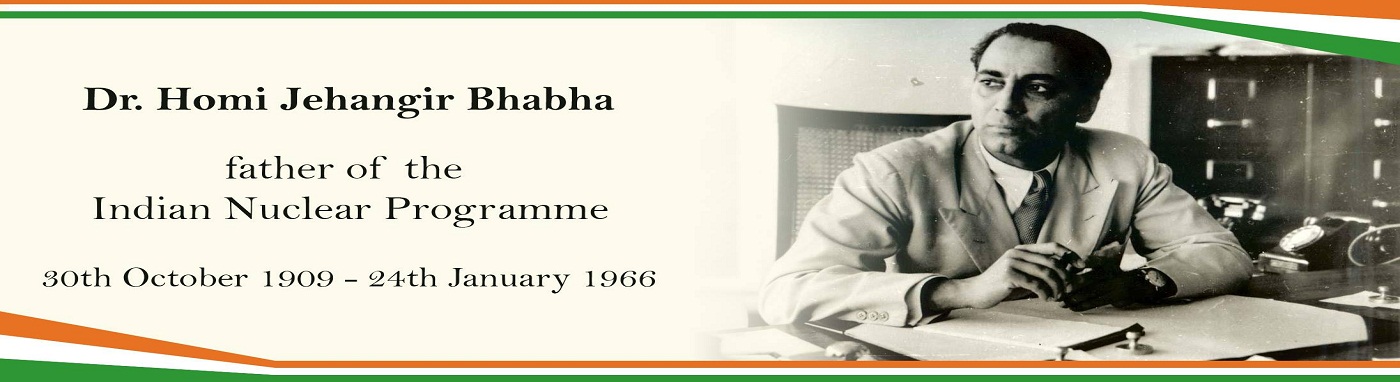
Homi Jehangir Bhabha
-
- Born in Bombay on October 30 1909, Dr.
Bhabha was educated at Cambridge, where he was exposed to the emerging
fields of quantum electrodynamics and meson theory. He made
important research contributions in these fields before returning to India
at the age of 31. He had the vision that India could enter a new era
of development in modern science and technology. His ideal was to
further the cause of science, both for the sake of enhancing human
knowledge, and for its potential to bring about economic prosperity and
social change.
-
- In 1943, Homi Bhabha approached the
industralist J.R.D. Tata, requesting his support towards the establishing
of a scientific institution. Two years later, the Tata Institute of
Fundamental Research (TIFR) began functioning under Bhabha's
directorship. In subsequent years, Dr. Bhabha presided over the
consolidation, expansion and diversification of the Institute's
activities. Simultaneously he turned his attention to the setting up of an
Atomic Energy research facility at Trombay, today known as the Bhabha
Atomic Research Centre (BARC). He was also instrumental in setting
up the Space Commission and the Electronics Commission.
-
- Homi Bhabha was a great builder of
institutions and an excellent science administrator. He was strongly
involved with science in India as a whole and with the academies of
science in particular. He was Vice President of the Indian Academy of
Sciences and President of the Indian National Science Academy. In
addition, he would often give expression to his artistic talent through
such pursuits as music and painting. His sensibilities showed in his
attention to minute details concerning architecture and overall
aesthetics.
-
- His tragic demise in an air accident in
1966 was a shock to the scientific community and to the Institute he had
founded and nurtured.Fortunately, the structures which had resulted from
his unique vision proved to be highly resilient. The Institutions he
founded and nurtured have continued to grow and flourish and today Bhabha
is considered one of the principal architects of modern Indian Science.
-
-
- Chen Ning
Yang, Nobel Laureate
-
- Brief Summary:
-
- Prof. C.N. Yang is legendary for his
theoretical work proposing that “parity” (the exchange of “left-handed”
and “right-handed”) is not an exact symmetry of the basic laws of
nature, for which he shared the 1957 Nobel Prize. He also wrote down
certain mathematical equations together with Robert Mills which have today
become the foundation of our understanding of elementary particles and
forces.
-
- Extended writeup:
-
- Prof. C.N. Yang is legendary for his
theoretical work proposing that “parity” is not an exact symmetry of
the basic laws of nature, for which he shared the 1957 Nobel Prize.
Until this time it had been thought that parity, the exchange of what we
mean by “left” and “right” as happens in a mirror, was a
fundamental symmetry of nature and therefore no physical process could
distinguish between a left-handed object and its right-handed counterpart.
The parity violation proposal overthrew this belief and was later
confirmed by experiments on atomic processes. While parity violation is
today an established fact about nature, scientists still strive for a
basic understanding of why it is the case.
- In 1954, Yang together with Robert
Mills wrote down equations of enormous mathematical beauty that appeared
to describe particles similar to the photon, the carrier of light. Such
particles were not known at the time. Theoretical work by many scientists
provided a physical setting for the the Yang-Mills equations and the
corresponding particles were then discovered experimentally: the “W”
and “Z” particles responsible for nuclear processes like radioactive
decay, as well as the “gluon” particles responsible for tightly
binding protons and neutrons together inside the atomic nucleus. Today the
Yang-Mills equations are the foundation of our understanding of
fundamental particles and forces.
-
- Prof. Yang has also published seminal
works in diverse areas of physics including statistical mechanics,
elementary particle physics and mathematical physics.
-
-
- Carlo Rubbia,
Nobel Laureate
-
- Brief Summary:
-
- Prof. Carlo Rubbia led the team at CERN
in Geneva that discovered the “W” and “Z” particles that are
fundamental to our understanding of nuclear forces. He has subsequently
carried out landmark research on alternative methods of energy production,
both nuclear and solar.
-
- Extended Writeup:
-
- Prof. Rubbia has worked at CERN
(European Organization for Nuclear Research) in Geneva since 1961,
becoming its Director General from 1989 to 1994. In 1976, he suggested
adapting CERN's Super Proton Synchrotron (SPS) to collide protons and
antiprotons in the same ring and the world's first anti-proton factory was
built. The collider started running in 1981 and, in early 1983, an
international team of more than 100 physicists headed by Rubbia and known
as the UA1 Collaboration detected the “W” and “Z” particles that
are fundamental to our understanding of nuclear forces. In 1984 he was
awarded the Nobel Prize for Physics.
-
- During the 1990s Rubbia proposed the
concept of an energy amplifier
(ADS) – a novel and safe way of producing practically unlimited nuclear
energy exploiting present-day accelerator technologies from natural thorium and depleted uranium. The energy
resources potentially deriving from this technology, which is actively
being studied worldwide, will be practically unlimited and
non-proliferating.
-
- He has also developed a novel method
for concentrating solar power at high temperatures for energy production,
known as the Archimedes Project, which is presently being developed by
industry for commercial use. He is now pursuing his solar programmes in
Spain. He is currently principal Scientific Adviser of the Spanish
Research Centre for Energy, Environment and Technology (CIEMAT).
-
-
- S.K. Malhotra
- Head, Public Awareness Division
- DAE
-