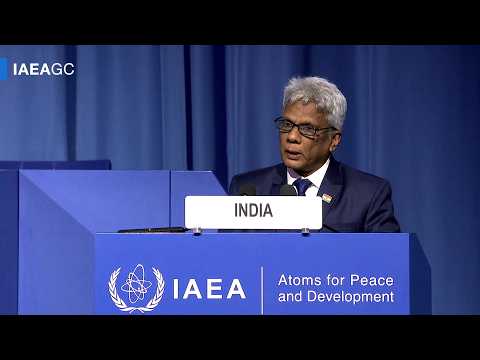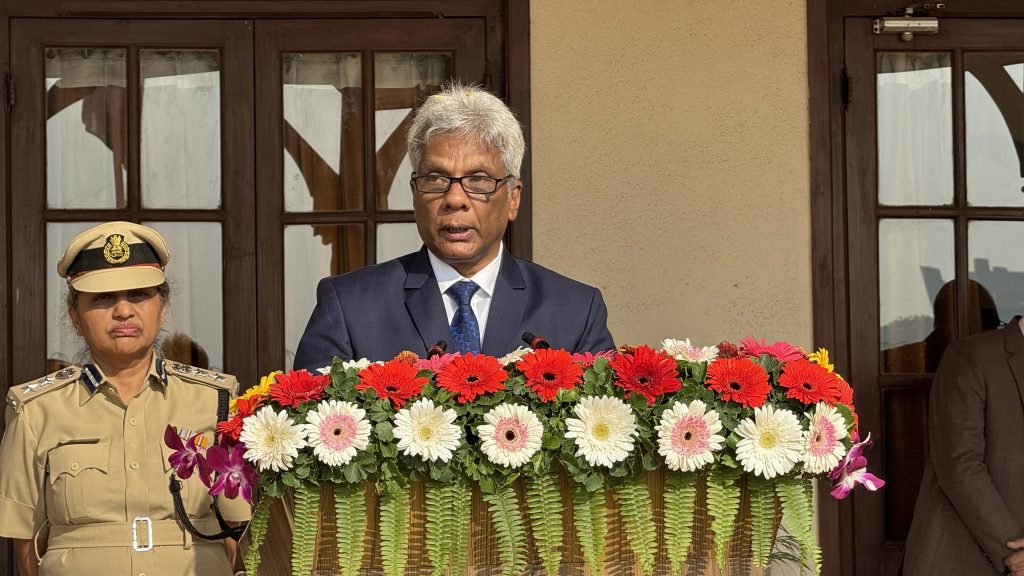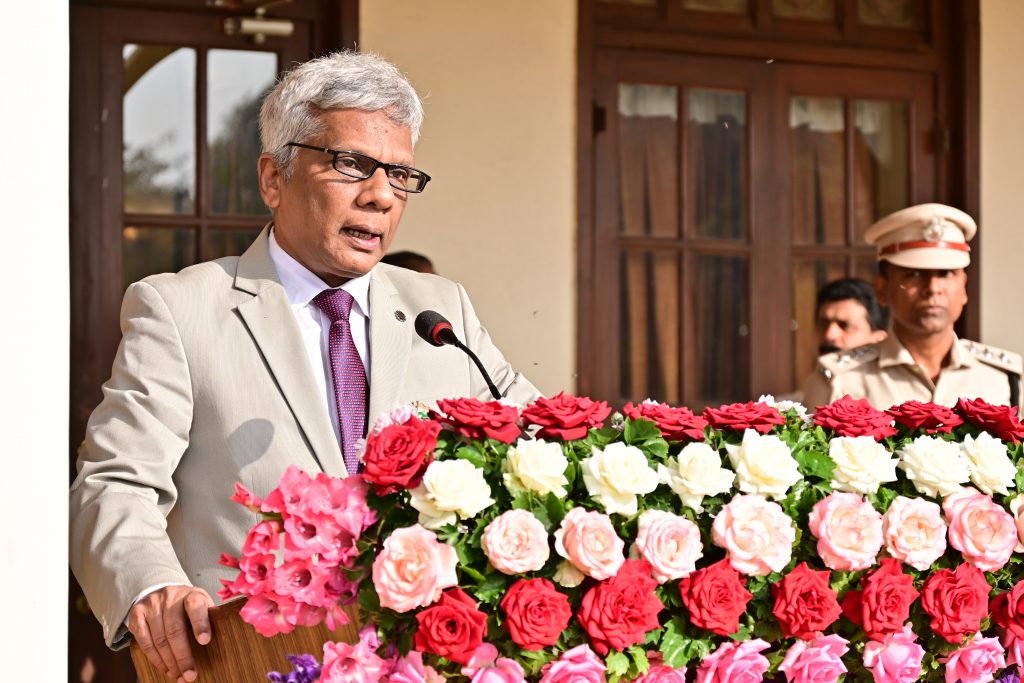



Address by Dr. Anil Kakodkar, Chairman, Atomic Energy Commission, at the Indo-French Nuclear Industry Business Meet in Mumbai on 15th October 2007.

 Excellency Mr. Jerome Bonnafont, Ambassador of France in India; Mrs. Sophie Galey-Leruste , Director of Energy and Mineral Resources, Ministry for Ecology, Sustainable Development and Spatial Planning; my colleague Dr. S.K. Jain, Chairman & Managing Director, NPCIL; Mr. Venkatachary; distinguished representatives of French and Indian industries present here; friends from the French Mission, Colleagues from Department of Atomic Energy, Ladies and Gentlemen,

 I am happy to welcome all of you present here, specially our guests who have come from France .

 Co-operation between India and France in the nuclear area is quite old.  In fact, it was the first bilateral co-operation India had with any country.  The co-operation has been very meaningful and covered  important areas like R & D, Fast Breeder Reactors, Safety and now Fusion Energy.  I also remember a similar industry meet that took place in Mumbai some twenty years ago which was focussed on the French PWRs.

 Importance of nuclear power in India has been recognized right since our independence.  Recognizing the need for technological independence  in this sensitive area, we launched  a unique and self reliant development of our three stage        nuclear power programme aimed at a long term objective of meeting a large share of our energy needs utilizing our vast Thorium resources.  This programme is on track.  Nearly half of the 10,000 MWe programme for the first stage based on domestic Pressurised Heavy Water Reactors (PHWRs) is already in place.  Another 8 units of 700 MWe, the unit size for our next PHWRs would complete the full power potential of the first stage that available domestic natural uranium would permit.  NPCIL has already demonstrated construction, operation and economic performance, matching the global standards and has the capability to construct all these eight units and more simultaneously.

           We have also launched the commercial phase of the second stage of our programme. The construction of the first 500 MWe Prototype Fast Breeder Reactor is making rapid progress.  A 300 MWe Advanced Heavy Water Reactor, a technology demonstrator for large scale thorium use in an advanced system that would meet all objectives of a 4th generation reactor, is also ready for launch of construction.

           The three stage development programme is thus very much on course and has seen faster progress in recent years than any time before. One must, however, understand and appreciate the sequential nature of this technology deployment strategy.  The nuclear properties of Thorium, while would permit sustaining a given power generation capacity to make full use of energy from our vast thorium reserves, do not permit growth in power generation capacity.  Large scale deployment of thorium has thus to await enhancement of power generation capacity through fast breeder reactors to a requisite level.   This is not a matter of reactor technology choice but inherent nuclear properties of thorium.

           Many of you are probably aware of a DAE study done some years back on electricity needs in India and the role nuclear power can play in meeting these needs over a five decade horizon.  It is clear from this study that the domestic nuclear power development could cater to around 208 GWe capacity out of a total 1300 GWe installed capacity that we need to realize to sustain the economic growth and there would be around 30% short fall in energy that would need to be imported to meet our needs.  These estimates have been arrived at after liberally taking into account contributions from all forms of energy.  We must also recognize that access to energy supply is likely become more and more difficult in coming years.

           Our efforts look at international civil nuclear co-operation have to be seen in this background.  We have insisted and would continue to insist that such co-operation can not be allowed to hinder our strategic programme as well as our three stage programme.  We have also insisted on our requirement to reprocess and recycle the spent fuel so that we not only have the additionality in the near term, which is very desirable, but also establish an order of magnitude larger power generation capacity along with its energy supply, for the future.  We must recognize the long term benefit of such energy resource in light of gaps in our future energy resource availability.  Access to larger availability of uranium either domestically or from abroad is yet another way to enlarge the nuclear power generation quickly. While we are pushing domestic uranium exploration and production at an unprecedented pace maximizing both resources and technology inputs, access to uranium abroad would happen only after civil nuclear co-operation opens up.

           France is an excellent example of how energy security can be realized through nuclear route in an environmentally benign way.  Today, France reprocesses and recycles almost the entire spent fuel that arises from its fleet of PWRs.  France is also the host for ITER project which would demonstrate to the world how one can augment global energy supply through almost unlimited fussion energy.  India is happy to be a partner in this global effort in which almost half of the humanity is participating.  India is committed to make in-kind contribution through equipment manufactured in the country costing around Rs.2000 crore. I am glad that ITER forms an important part of the agenda of this meet.

           Discussions have been held between parties in France and India on industrial co-operation in manufacture of PWR equipment in India .  This is an important element in competitive economic viability of French PWRs in India .  I think this could also be of advantage in terms of enhancing competitiveness of French PWRs world wide.  Indian industries today make and supply equipment for our PHWRs and FBRs.  They are also well qualified to make PWR equipment.  Indian energy requirements are large and hence Indian manufacturing industry has the opportunity to meet all emerging requirements including  possible needs for the global market.  We will of course maintain our self reliance.  Self reliance to me does not mean isolating ourselves.  But rather keeping several options including ‘do it yourself’’ option open so that the country is not subject to vulnerabilities of any kind.  With the commitment to move on the three stage programme at an accelerated pace and the robust capabilities that have been already built, I am confident that the collaboration of the kind we are envisaging would be a win-win situation for both sides.

           NPCIL and BHAVINI, the two DAE public sector units have the experience of setting up and operating a diverse set of nuclear reactor technologies such as BWR, PHWR, VVER and FBR.  This capability has been built over decades and is duly backed up by R & D laboratories of DAE like BARC, IGCAR and RRCAT.  NPCIL has also evolved a management culture that has imbibed the specific requirements nuclear power business.  A nuclear reactor once started needs to be looked after to keep its safety functions going, whether it generates electricity or not.  This management commitment has to last all the way up to the end of decommissioning process and also until all spent fuel is reprocessed and waste properly disposed off.  This is a learning process and we must see evidence of adequate preparedness before any entity is allowed to get into this business.  It is also clear that regulatory approval from Atomic Energy Regulatory Board is necessary for any nuclear / radiation related activity in India .  Further, any reactor design must be licenced in the country of origin before it can be considered here.

           This Indo French Nuclear Industry Business meet provides a unique opportunity to exchange ideas at the industry level and prepare ourselves together for meeting emerging requirements in India which by themselves are bound to be quite large.  Hopefully, discussions would also facilitate India to be a good partner in fulfilling the needs of global nuclear renaissance.

           I wish you all success in your deliberations.

--------------