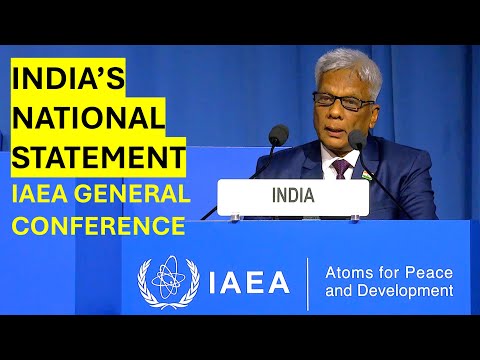




Statement by India at IAEA Board of Governors Meeting
on 1 August 2008

Mr. Chairman, 
Allow me to convey on behalf of the Indian delegation our warm congratulations on the most efficient manner in which you have been conducting the proceedings of this Board.

I take this opportunity to convey our deep appreciation to the members of the Board of Governors as well as the Director General for the important decision adopted today by according approval to the document contained in Gov/2008/30, which is the “Agreement between the Government of India and the International Atomic Energy Agency for the application of Safeguards to Civilian Nuclear Facilities.” I would also like to convey our deep appreciation to the Agency Secretariat, and the negotiating team which led to the finalization of the Safeguards Agreement with India. In INFCIRC/731, India has indicated its intention to move forward with its Separation Plan in accordance with the provisions of the Safeguards Agreement, after its entry into force.

Mr. Chairman,
This is an important day for India and a significant milestone in the long standing cooperation between India and the Agency. We pledge our support to the further strengthening of the Agency’s role in promoting international cooperation in the peaceful use of nuclear energy, which is so critical to ensuring a clean and secure energy future. We look forward to cooperating with the Agency to facilitate the implementation of this Agreement in accordance with the provisions of this Agreement which, as the Director General has pointed out, should be read as an integral whole. 

Mr. Chairman, 
India’s population accounts for one sixth of mankind. The pursuit of the goal of energy security is one of the most pressing challenges for India, which has registered an economic growth of 9 percent in recent years. We aspire to achieve and maintain a growth rate of 10 per cent order in order to ensure development to lift millions of our people from poverty and provide sustainable livelihood. To sustain this kind of growth, India would have to ensure availability of adequate quantum of energy, particularly electricity. The generation of electricity in fact would need to grow at an annual rate of 8% to 10% in order to meet the needs of our growing economy.

Even as we explore alternative sources of energy such as hydropower and renewables such as solar, only nuclear energy has the potential to make a major contribution towards satisfying India’s requirements and at the same time address the global challenges of energy security and climate change. India’s current electricity generation is primarily based on coal. India’s reserves of coal would be inadequate to meet our needs after 2050. Even by accounting for all domestic energy resources, India would need to import energy to the tune of 1.6 billion tonnes of coal equivalent annually. Taking into account the current international scenario with respect to global energy supplies and prices and India’s large energy requirements, it would be unrealistic to depend heavily on hydrocarbons. It is also a fact that large-scale use of coal will have an adverse effect on the environment and global climate, a situation that is unavoidable if nuclear power is not able to make a significant contribution.

We live in an interdependent world and we share the common global concerns on the need to tackle the problem of greenhouse gas emissions and global warming. Nuclear energy, which is recognized today as a clean and environmentally friendly source of energy that can meet the twin challenges of sustainability and climate change, is indispensable to addressing our common energy future. 

Mr. Chairman, 
On the basis of a robust self-reliant R&D, India has built its own vibrant programmes in Pressurised Heavy Water Reactors, Fast Reactors, Thorium Reactors and related fuel cycle technologies as part of our three stage nuclear programme. A large scale expansion of nuclear power based on these technologies is currently underway. As a country which has mastered all aspects of the nuclear fuel cycle, India remains prepared to engage actively with others to ensure that the global nuclear renaissance will help realize our shared vision of using nuclear power as an abundant and secure energy source. 

India is already an observer at CERN and is partnering several other countries in the construction of LHC which is nearing completion. India is also a partner country in the International Thermonuclear Experimental Reactor ITER project along with other countries having advanced capabilities in the nuclear field. We believe, such cooperative ventures have been mutually beneficial. 

India’s integration into the global civil nuclear community is thus a win-win situation for all. Global efforts to promote energy security, sustainable development and effective non-proliferation will stand to gain with India as a partner. Our national export controls will remain on par with the best international standards. We have our principled and consistent position on nuclear non-proliferation and disarmament issues. We remain firm in our commitment to realize the vision of the Rajiv Gandhi Action Plan for universal, non-discriminatory nuclear disarmament leading to the complete elimination of nuclear weapons. 

Mr. Chairman, 
The Safeguards Agreement approved by the Board today was negotiated by India and the Agency also using the guidance documents adopted by the Board for the purposes of concluding and implementing INFCIRC-66 type Agreements. The safeguards agreement speaks for itself and we see no difficulty in implementing this Agreement on the basis of what is stated therein. India will implement this Agreement in strict accordance with its provisions. In implementing this Agreement India and the Agency can build on the excellent cooperative relations that have so happily existed between us. As the DG has already indicated, India and the IAEA have begun discussions on an Additional Protocol to this Safeguards Agreement.

Thank you, Mr. Chairman.