


|
FAST
BREEDER PROGRAMME :
AN INEVITABLE OPTION FOR ENERGY SECURITY
Dr.Baldev Raj
Director, Indira Gandhi Centre forAtomic Research
|
Let us celebrate the success
of our nuclear power development scientists and engineers
and their partners in the industry for making the dream of
fast breeder reactor a reality for the nation, which will
lead the country towards total energy security within the
next two decades. Let us empower the nation with quality power.
Dr.A.P.J.Abdul
Kalam ,
2004-Technology Day Speech,
AIR
|
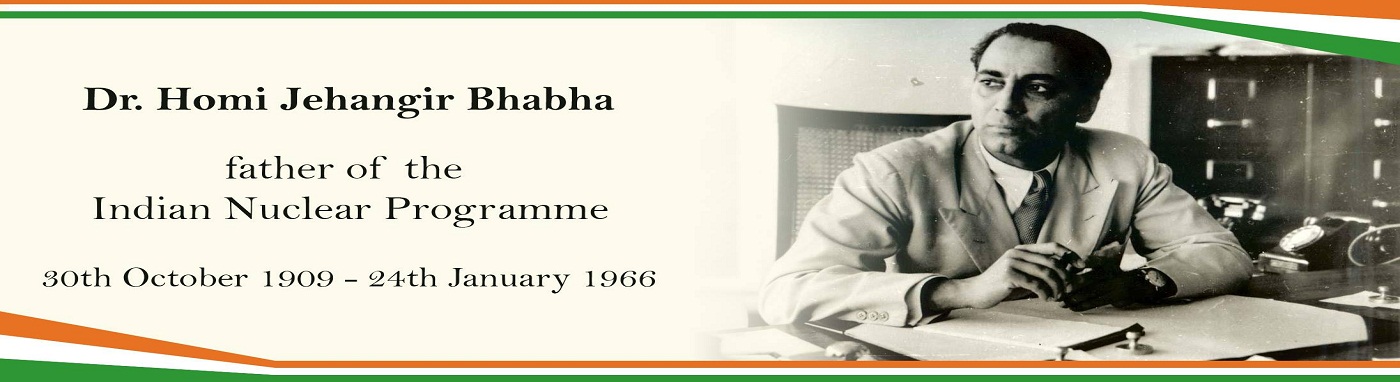
Vision of a 3-stage Nuclear Power Programme enunciated
by Dr. Homi Jehangir Bhabha was indeed the beginning of a dream for
energy security in the country. The vision took cognizance of the
limited uranium and vast thorium resources within the country. The
first stage, namely Pressurised Heavy Water Reactor Programme (PHWR)
has now matured into a robust technology with the capacity factors
touching 90% consistently. These reactors use natural uranium as the
fuel which contains only 0.7% of fissionable Uranium-235. Hence, the
PHWR programme cannot be taken beyond a power level of ~10,000 MWe
based on the presently known and exploitable indigenous resources
of natural uranium. In a fast neutron spectrum that exists in Fast
Breeder Reactors (FBR) beside fission of Uranium 235, there is gainful
conversion of the 99.3% Uranium-238 to plutonium -239, which in turn
is a fissionable material. When the fissile material produced is more
than that consumed, the reactors are referred to as Breeder Reactors.The
effective utilization of the indigenous uranium resources is therefore
possible only through the FBR route, by which India can achieve a
power capacity of 300,000 MWe. It was Dr. Vikram Sarabhai, who recognized
the inevitability and complexity of FBRs in India and put into
action the second stage of countrys Nuclear Power Programme.
For this purpose, he created a road map for a truly interdisciplinary
research in reactor engineering, materials, chemistry, reprocessing,
safety, instrumentation and other allied disciplines, which finally
led to the establishment of the Reactor Research Centre, later renamed
as Indira Gandhi Centre for Atomic Research (IGCAR).
Fast Breeder Test
Reactor
The story of Fast Breeder Test Reactor (FBTR) is itself a proof of the
strength and resilience of the Department. It is exemplified by landmark
achievements in all facets right from design to commissioning and finally
achieving the objectives. The agreement with CEA, France in 1971 was
only for the transfer of the design of Rapsodie type reactor, training
of personnel and transfer of manufacturing technology. The responsibility
for construction was totally with India. FBTR includes the steam generator
and associated steam system which was absent in Rapsodie. Except for
the grid plate, one control rod drive mechanism, one sodium pump and
raw materials for critical nuclear components, which were imported from
France, all the other components were manufactured in India. Sodium
purification rig was set up at this Centre and 150 tonnes of reactor
grade sodium coolant for Fast Breeder Test Reactor was prepared from
commercially available grade. The total indigenous content of FBTR is
more than 80%, considered quite high in the light of the standards of
Indian industries in the seventies and eighties.
New Fuel
The original design of MOX fuel with plutonium oxide (PuO2) and / uranium
oxide (UO2) (with the latter enriched to 85%) was reviewed in the light
of the embargo due to the Peaceful Nuclear Explosion (PNE) by ndia in
1974, denying supply of enriched uranium. It was a challenge to the
start of the second stage programme of nuclear energy in India. It was
also an opportunity to develop advanced fuels. The DAE took a bold decision
to develop mixed carbide fuel with high Pu content. Being a unique fuel
of its kind without any irradiation data, it was decided to use the
reactor itself as the test bed for this driver fuel. The synergism between
the different units of the department like BARC, IGCAR and NFC, has
resulted in success of this bold initiative.
The reactor has been operated up to a maximum power 17.4 MWt. Eleven
irradiation campaigns have so far been completed. The fuel has seen
a burnup of 123.5 GWd/t (energy generated in the fuel multiplied by
days of operation per tonne of fuel consumed) without failure. This
has been possible by the encouraging results obtained from Post Irradiation
Examination studies conducted on fuel subassemblies discharged at intermediate
stages (25,50,75&100GWd/t). Based on extensive work done by multidisciplinary
team, the burnup of level of 150 GWd/t is now a reality. In addition
to its use as a self-driven irradiation facility for the Pu-rich monocarbide
fuel, FBTR is being utili- sed as a irradiation facility for fuels and
materials. Currently, FBTR is being used to irradiate the MOX fuel (29
% PUO2) chosen for PFBR (500MWe) to the target burnup of 100 GWd/t .
These are truly international landmarks made possible due to interorganizational
and interdisciplinary collaborative work.
Operation Experience
All the sodium pumps have been giving trouble-free service for more
than 1,20,000 hrs. Sodium purity has been well maintained. Corrosion
is so negligible that the engraved identification numbers on the fuel
pins resident in the reactor for 18 years could be easily read in the
hot cells during post-irradiation examination. The once-through serpentine
steam generators have operated without any tube leak. The Steam Generator
Leak Detection System has given trouble-free and continuous service.
This success demonstrates our strengths in the areas of manufacturing
technology, sensor development and reactor instrumentation.
Safety Experience
Several safety related engineering and reactor physics tests have been
conducted in FBTR to validate the data and the codes used in design
and safety analysis of the reactor. The completed physics tests include
measurement of the various feed back coefficients of reactivity, effect
of sodium voiding of the reactor, flux measurement above sodium and
evaluation of performance of the failed fuel detection system. The completed
engineering tests include study of the evolution of various reactor
parameters during postulated incidents of high and low probabilities.
A major low probability event was tested to assess the capability for
removal of decay heat from the reactor by natural convection in the
primary and secondary loops under conditions of non-availability of
all the sodium pumps. All the tests have proven that the reactor is
quite safe under all postulated incidental scenarios. The maximum annual
activity released to atmosphere so far is 128 Ci. Cumulative occupational
exposure so far is only 50 man-mSv (5 manrem). During the operation
of FBTR, there has been no significant event of abnormal radioactivity
release, personnel or area contamination thus confirming our conviction
that the sodium cooled reactors give low radiation doses to operating
personnel and low releases to environment.
Our Strength
The experiences in construction, commissioning and satisfactory operation
for the past 18 years have demonstrated the mastering of the multi-disciplinary
technology for energy production using a fast reactor and provided sufficient
feedback to enable the launch of PFBR. Further, India has gained maturity
in the design, operation and maintenance of FBR system. Most important,
it has created a pool of specialists in the various disciplines related
to complex technology of fast reactors.
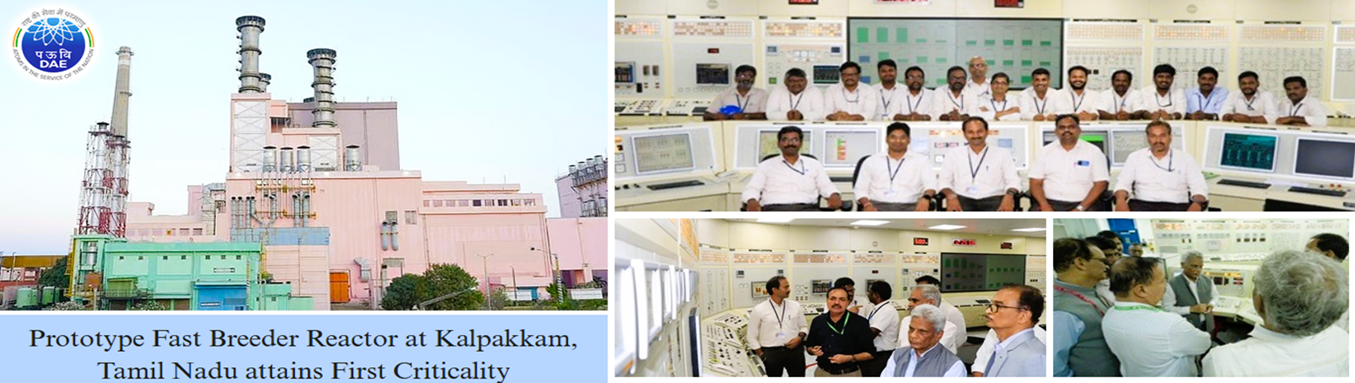
PFBR
The preliminary design of the PFBR reactor was prepared in the early
eighties. The choice of plant capacity 500 MWe was decided as the steam
conditions of PFBR were close to 500 MWe thermal station. The higher
plant capacity also meant taking advantage of economy of scale reducing
cost of generation. The initial design had four heat transport loops
feeding a total of 36 steam generators, 9 in each loop. There were four
primary pumps and equal number of secondary sodium pumps with 8 sodium
to sodium heat exchangers (IHXs) to transfer heat from primary circuit
to secondary circuit before steam could be raised in the steam generators
of the secondary circuit. A large part of the 1990s saw the design and
engineering research & development groups going through the optimization
phase, when a detailed look at reducing the number of loops and components
was taken to produce a techno-economic design to demonstrate viability
of such large plants without compromising availability and safety. The
design that evolved had only two primary pumps, four intermediate heat
exchangers (IHXs), two secondary heat transport loops and eight steam
generators in all, making a substantial reduction of components from
the earlier design.
In retrospect, there was a lot of advantage of the optimization process
both for the designers and development engineers who got better insight
in the design. In the area of sodium pump, a new hydraulic design has
been developed based on extensive tests. Electomagnetic pumps and flowmeters
have been designed, built and tested in-sodium. With several sodium
facilities for components testing, instrumentation qualification, sodium
technology has reached a level of maturity at IGCAR. Starting from a
500 kW sodium test facility, the Centre now has the 5.5 MW steam Generator
Test Facility. To understand the hydraulics within the primary pool
of the reactor, a large test facility at 1/4 scale ( SAMRAT ) of the
primary circuit, has been commissioned at this centre. Specialised thermal
hydraulics and structural mechanics investigations have been carried
through computer codes developed inhouse and validated through in house
experiments carried out in sodium and water and also International Benchmark
problems. All design basis events including off normal and accidental
situations have been analysed with these codes. Complex failure modes
under thermo- mechanical, vibration, seismic and accidental loadings
have been analysed and structural integrity demonstrated for safe operation
for a design plant life of 40 years. A boron enrichment facility has
been operated to develop the process flow sheet for obtaining enriched
boron for control rods for FBR. A flowsheet for obtaining enriched boron,
extraction of elemental Boron-10 and manufacturing compact pellets for
PFBR has been finalized and an inter-organizational team from the department
of atomic energy ( BARC, IGCAR, HWB) is working on the project.
In the area of Control and Instrumentation, the fault tolerant real
time computer systems have been developed and commissioned successfully
in FBTR and new improved systems are in the pipeline for PFBR. Capabilities
to simulate and test the different instruments and system have been
developed inhouse. A full scope Training Simulator is being built for
operator training.
Reprocessing
Closing the fuel cycle is a key element of the FBR programme, without
which it is not possible to realise growth in nuclear power. Reprocessing
activities started with processing of irradiated thorium rods for separating
U-233.This U-233 has been used for fabrication of Mixed Oxide fuel test
assembly for irradiation in FBTR, before use in PFBR. A pilot plant
scale reprocessing facility has been commissioned and reprocessing of
FBTR fuel has commenced successfully. The flowsheet, as well as equipment
development was based on extensive numerical and experimental simulation,
carried out indigenously. The reliable and trouble-free operation of
the equipment has given the confidence to take up the challenge of large
reprocessing plant matching throughputs of fuel from PFBR.
Manufacturing Technology Development
Manufacturing technology development for full size components for PFBR
was thought to be crucial for successful construction of the reactor
without cost and time over-runs. In the light of this realisation, a
programme of manufacturing development of components like the main vessel,
inner vessel and the roof slab of the reactor, so also the full scale
control and safety rod mechanism, the invessel fuel transfer machine,
steam generator etc. were taken up with selected Indian industries.
These components and several others have undergone or undergoing various
tests including those in liquid sodium. A comprehensive programme to
address problems related to inservice inspection of reactor components
has resulted in development of non- destructive tests (NDT) using ultrasonic,
eddy current, magnetic particle testing, thermography etc..
Materials Development
The development of indigenous materials for core structures, steam generator
and other components of the reactor is vital for the FBR programme and
comprehensive range of facilities for studies of metallurgical properties
have been set up. This development was undertaken to assure availability
of indigenous sources in case of embargo. All the materials (SS304,316,316
LN, Modified 9 Cr-1 Mo) have been produced and have undergone tests
for carbon transfer, corrosion etc. in sodium. Also the mechanical behaviour
of these materials have been measured in sodium at high temperatures
and have certified their performance. Weldability of steels is another
important area where extensive R&D has been carried out and mechanical
behaviour of welds under monotonic and cyclic loading conditions established.
Welding consumables have also been developed indigenously.
PFBR Launched
The above approach of development has led to a competitive design backed
by vast amount of tests and mastering of the manufacturing technology.
For the R&D, many collaborative works were carried out with educational
institutes, R&D labs. and public and private sector companies. The
Centre also has more than 100 research scholars at any time to support
the programme. The review of design by two eminent expert groups, has
led credence to design maturity. By 2000 AD, the Department felt that
the time to launch construction had come. The exercise of getting clearances
from the Ministry of Environment, Planning Commission, Ministry of Finance,
Power etc. was started. The financial sanction for the project was given
by the Cabinet in September 2003. The total project cost sanctioned
is Rs 3492 crore and the expected unit cost would be about Rs.3.25 in
the year 2010 when the plant is commissioned. The PFBR plant is being
constructed by a newly formed company called BHAVINI (Bharatiya Nabhikiya
Vidyut Nigam Limited) which comprises experts in project management
and construction drawn from NPCIL and the technological expertise from
IGCAR, BARC and other DAE units. This is indeed an example of optimizing
and synergising the resources to meet the challenging assignment in
a cost-effective manner. We are confident of completing the project
with less than sanctioned cost and stipulated time thus holding the
potential to reduce cost of energy production by PFBR.
Beyond PFBR
Vision 2020 of the Department envisages a series of four 500 MWe FBRs
after PFBR.
The cost studies indicate that a series construction of four at a given
site would reduce the cost by about 25% compared to PFBR and construction
time could be brought down to 5 years from 7 years. Constant improvements
in design, operation and material development would certainly result
in better capacity factors of the plants. Future plans are to go in
for 1000 MWe FBRs with improved design features and optimisation at
all stages. All efforts are focused on developing high burn-up and high
breeding fuel, advanced structural materials for longer life of FBRs
upto 60 years, development of better shielding materials, etc. Closing
the fuel cycle with high efficiency in an environmentally benign manner
is the priority in the programme. The challenges ahead are exciting
and highly rewarding to realise dreams of Dr. Bhabha through the courageous
path shown by Dr. Sarabhai. Interdisciplinary Colloboration, Interorganisational
synergy, multitasking by experts and the mobility of personnel from
one type of activity to another, have undoubtedly provided the impetus
for growth of FBRs in this centre.
Currently, international community has identified liquid sodium cooled
Fast Breeder Reactor as one of the five advanced and innovative types
of reactors to meet the future energy needs in safe and cost-effective
manner. However, India had unwavering faith in FBRs and pursued the
path with courage and conviction since 1970s. It can be said with confidence
that energy security for India, in the next few decades, would be realised
through FBRs.
|