



International Atomic Energy Agency

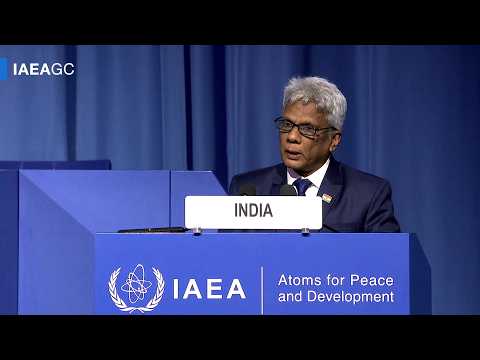
52nd General Conference, Vienna, 1st October, 2008


Statement by Dr. Anil Kakodkar,

Chairman, Atomic Energy Commission

and Leader of the Indian Delegation

Mr. President,

      Allow me at the outset to congratulate you on behalf of my Government, and my own behalf, on your election as the President of the 52nd General Conference of the International Atomic Energy Agency.  I am sure that under your able Presidentship, and with the support of your team and the Secretariat of the Agency, this General Conference will be able to accomplish the tasks before it.

      I also take this opportunity to welcome the entry of the Sultanate of Oman, the Kingdom of Lesotho and Independent State of Papua New Guinea to the membership of the International Atomic Energy Agency (IAEA).

     I would also like to compliment Dr. Mohamed ElBaradei, Director General on his able stewardship of the International Atomic Energy Agency for yet another year.  Through his tireless efforts, he has guided the work of the Agency so that it can be better prepared to face contemporary challenges and also realize the immense opportunities that lie ahead.

     Mr. President, this has been a remarkable year for India in the field of nuclear energy.  The approval by consensus of the Agreement for the Application of Safeguards to Civilian Nuclear Facilities by the IAEA Board of Governors on 1st August, 2008 (GOV/2008/30), and the Statement on Civil Nuclear Cooperation issued by the Nuclear Suppliers Group (INFCIRC/734) on 6th September, 2008 have created conditions for India to make an even bigger contribution to the growth of international civil nuclear cooperation. Here we would like to acknowledge the contribution and assistance of our close friends in the international community who have made it possible.

     While development of such cooperation will contribute to the strengthening of India’s energy security, India is also looking forward  to enhance its  assistance to friendly countries. India has an ongoing programme on 220 MWe PHWRs, a reactor system that is competitive in terms of capital costs, safety performance and unit energy cost. This system is well suited to the needs of countries with small electricity grids, especially those in the developing world.

     Today we have reached a critical point in global development efforts, which is marked by a huge increase in the energy requirements of emerging economies, unfulfilled developmental aspirations of a vast majority of the global population and the serious threat that our planet faces in terms of climate change.  According to the Inter Governmental Panel on Climate Change, “warming of the climate system is unequivocal, as is now evident from observations of increases in the global average air and ocean temperatures, widespread melting of snow and ice and rising to global average sea level”.  It is, therefore, clear that as we work towards meeting enhanced energy requirements, we need to realize this not in the business as usual mode but with much greater dependence on non-fossil energy sources.  Such an approach is necessary as a part of climate change mitigation strategies, as well as for sustainability of available energy resources.

     As an example here, I might mention that, as per the estimates made by our Planning Commission, India’s share of incremental world supply of fossil fuels could rise from a low of 13% in the most energy efficient scenario to a high of 21% in the coal dominant scenario by 2031-32.  India has, therefore, accorded high priority to realizing a significantly larger share for nuclear power in our overall electricity generation.  Rapid development of nuclear energy has the viable potential for making the necessary energy available for sustainable development of the world at large. 

     India has been practicing a comprehensive programme in atomic energy covering the entire fuel cycle in respect of uranium, plutonium and thorium based fuels.  While the three stage development of our nuclear programme is dictated by our prime long-term objective of realizing energy independence on the basis of our vast thorium resources, our understanding and experience with thorium clearly reveals several benefits of the thorium fuel cycle, particularly in heavy water reactors, in terms of proliferation resistant nuclear energy production as well as efficient fissile plutonium disposal which may also be of interest to other countries.  We are organizing a side event this Friday that would highlight the role of Thorium in this regard in some detail.         

     Mr. President, I would now like to present a few highlights from Indian nuclear power programme, which has by now clocked 285 reactor years of safe and economic nuclear power generation.  A new national record for continuous power operation was achieved by the Kaiga – 2 reactor by registering 529 days of uninterrupted run during August 2006 to January 2008.  In addition to the seventeen operating reactors, three 220 MWe Pressurised Heavy Water Reactors, two 1000 MWe Light Water Reactors and one 500 MWe Prototype Fast Breeder Reactor (PFBR) are currently in advanced stages of construction. An important milestone of erection of the 13.5m diameter safety vessel into the reactor vault of PFBR was reached in June 2008.  I am also happy to inform you that the MoX fuel for PFBR, which is being irradiation tested in the Fast Breeder Test Reactor at Kalpakkam, has now reached a burn-up of 80,000 megawatt days per tonne of heavy metal. The initial construction activities related to Fast Reactor Fuel Cycle Facility that would recycle the PFBR fuel have commenced.  The programme of development of metallic fuels that would enable shorter doubling time of fast reactor capacity is moving on course.  We are also pursuing pre-project activities for four 700 MWe PHWRs and development of a new uranium mine at Tumallapalle.           

     A new critical facility for validating the physics design of the thorium based Advanced Heavy Water Reactor core, as well as for investigation of core lattices based on various fuels, moderator materials and reactivity control devices is now operational at the Bhabha Atomic Research Centre and is being used  for various experiments for the purpose.  The design of a new multi-purpose research reactor is progressing well and studies are currently underway to incorporate features in the design for its possible coupling to a lead-bismuth-eutectic spallation neutron source driven by a 650 MeV proton beam.  The 3rd generation high level waste vitrification melter based on cold crucible technology has been in regular operation.  Based on the operational feedback,  a new melter has been designed and is under manufacture. An industrial electron beam irradiator based on 10 MeV RF-LINAC has been commissioned.  This machine is capable of delivering an electron beam over a 100 cm x 5 cm area in air for various materials processing applications.  A 1:4 size model of our 540 MWe PHWR containment has been constructed to conduct experimental studies on various failure modes of the containment up to its ultimate load capacity.   An international round-robin exercise has been organized using the results of these experiments that will enable bench marking of various computer codes for analysis of containment behaviour under accident conditions.  Similarly, there are other major round robin exercise activities being pursued in India covering large RCC structures, tsunami effects, atmospheric dispersion, etc.  We would welcome participation of interested research groups in these exercises.  INDUS II, the 2.5 GeV Synchrotron at Raja Ramanna Centre for Advanced Technology at Indore has reached its full energy level with a number of experimental beam lines operational.  The Superconducting Cyclotron at Variable Energy Cyclotron Centre, Kolkata has also been commissioned with an internal beam.  

     India has also played an important role in several international projects that help further fundamental nuclear research.  We are happy that the LHC has been completed and would start producing valuable experimental results as soon as the initial teething troubles are overcome.  We value our participation in the ITER project which is important in terms of the long-term energy needs of the world.  India is also participating in FAIR and many other mega-science projects. 

     Mr. President, I am also happy to inform this august gathering that in the area of cancer treatment , the indigenously developed tele-cobalt machine, Bhabhatron, is increasingly being sought after by cancer hospitals.  Nine Bhabhatrons have already been installed and more are currently under manufacture.   On the nuclear  agriculture  front, 8 new mutant varieties were notified by the Central Government for commercial cultivation during the year.  This takes the total mutant varieties developed in BARC to 35.

     As a member of the IAEA’s INPRO activity right since its inception, we are glad to note the progress made during recent years.  India is a participant in eight of the twelve Collaborative Projects under INPRO Phase – II.  The collaborative projects, particularly in the fields of water cooled reactors, fast reactors, high temperature reactors, and thorium utilization, have been offering an unique opportunity for the participating Member States to jointly work towards taking these technological approaches forward, to fulfill the needs of the future and to cater to enhancement of  the volume, reach and range of deployment of nuclear energy in the world.  It is rather ironic that this important technological activity, which is at the core of a holistic solution to global access to nuclear energy in a safe, secure and sustainable manner, is still not a part of regular budget of the Agency.  We once again stress on the need to provide full budgetary support to the INPRO activities, which we believe would be a most efficient and sustainable use of the Agency resources in meeting its objectives according to its Statute.     

     Mr. President, human development has primarily resulted from creative thinking and actions based on observations of things around us.  Science and Technology has played a major role in this evolution.  At the current crucial juncture, when the ability to access the vast energy potential of the atom by all is the need of the hour to prevent widening of disparities, fears arising out of the destructive power of atom are preventing wider access.  Several proposals for solutions are on the table.  While one needs out of box ideas to make progress, it is clear that S&T based solutions are the ones that are  likely to be most successful.  Among all agencies in the UN family, the IAEA is uniquely placed in this respect as it has the necessary S&T resources with global representation.  What we need is to emphasise S&T approaches to such solutions and INPRO is a case in point.

     While we recognize the importance of nuclear power development world wide, we also need to take into account the factors that have constrained its growth.  The number of countries that have taken up construction of a new power reactor has remained stagnant at 33 since the year 1985.  However, there are ambitious plans now for expanding the nuclear power generating capacity in many countries and several countries have plans to build their first nuclear plant in the near future.  Clearly, the required infrastructure needs to be in place in a timely manner to service this nuclear renaissance.  One of the crucial elements of the infrastructure is the availability of trained human resources.  Fortunately in India we have a robust programme for manpower development that is in existence for over five decades now.  In keeping with the spirit of international cooperation, we would like to offer to train foreign young scientists in our Nuclear Training School, that regularly conducts a one-year orientation course for engineering graduates and science post-graduates, on mutually agreed terms.

     As members of a responsible global community, we need to understand the issues that inhibit access to nuclear power and find solutions for their resolution.  Clearly there are issues concerning human resources, capable infrastructure, safety regulation and security.  What we need is a balanced approach which maximizes development and minimizes risks.  The International Atomic Energy Agency, through its more than five decades of scientific and professional work, has established itself as a credible organization that fulfils its mandate as enshrined in its Statute.  With its strong science base and rich experience, the Agency is in a unique position to identify and promote holistic technological solutions that are optimum, that minimize constraints and are accessible to all. 

     The Director General’s bold initiative last year to set up the Commission of Eminent Persons (CEP) for going into the nature and scope of IAEA’s programme upto 2020 and beyond is highly commendable. The Report clearly brings out the need for a greater role for the Agency in piloting global development through the use of atomic energy which appears almost inevitable today.  While the Report does cover all relevant dimensions, especially the need for enhanced resources through regular budget, perhaps it could have been more balanced.  The Report, however, does not provide many practical ideas and strategies to enable new entrants to access the benefits of nuclear energy.  We would have been happier to see the focus of the Report on such and other related aspects within the scope of Agency Statute rather than on aspects outside. The CEP report alone, as it stands, cannot be the basis for IAEA’s future.  Clearly, more work needs to be done.  However, we welcome this opportunity provided by the release of the Report to generate constructive and practical ideas as to how the renaissance of the nuclear industry could benefit all countries, the developing countries in particular.

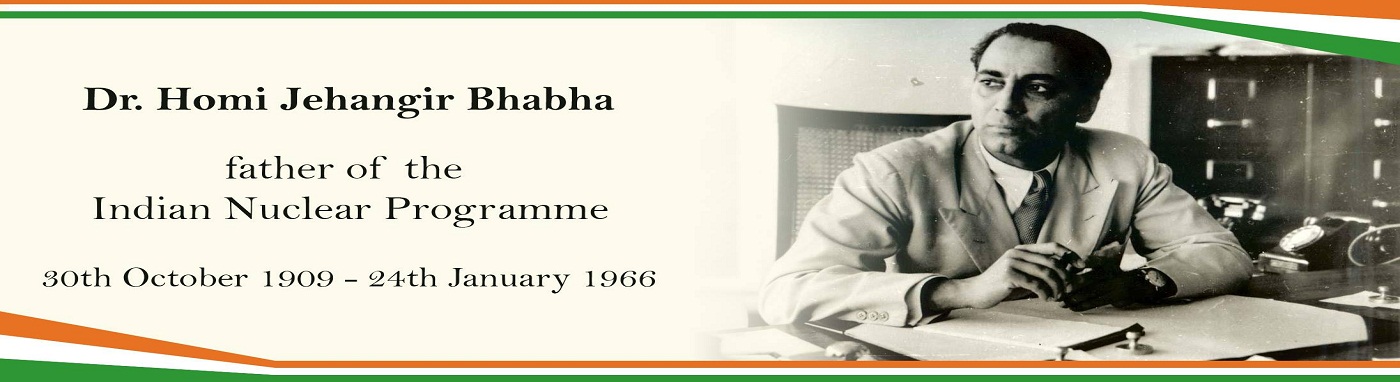
     Mr. President, on 30th October, 2008 we would enter the birth centenary year of the founder of atomic energy programme in India, the late Dr. Homi Jehangir Bhabha.  I am also happy to inform that during this Bhabha Centenary Year, and also to mark the Silver Jubilee Celebrations of the Indian Atomic Energy Regulatory Board, we will be hosting the IAEA International Conference on Topical Issues in Nuclear Installation Safety, that is scheduled to be held in Mumbai during 17-21 November, 2008.  As part of a year long Homi Bhabha Birth Centenary programme, we are planning to organize an international conference on “Peaceful Uses of Atomic Energy” and it will be our privilege if we can do this in cooperation with IAEA.  As many of you are aware, Dr. Bhabha was among the early group that worked on shaping IAEA and in fact was instrumental in having its headquarters located in Vienna.  Incidentally Dr. Homi Bhabha was also the President of the 1st Geneva Conference on “Peaceful Uses of Atomic Energy”

     Mr. President, in the march of human civilization every age and era is defined by a significant achievement; the use of fire, the invention of the wheel, locomotion through steam, the realization of power of the atom and the internet. We have now reached the final frontier. In this age we are at the threshold of the most exciting of possibilities - the power to understand and manipulate matter in the service of mankind. But this possibility will become a reality only if the nations of the world, and in particular the scientific community, come together and join hands in a manner not seen in the past. We are hopeful that the international nuclear community working together as one family within the framework of the IAEA, will not let this opportunity pass and take giant leaps towards harnessing nuclear power for the benefit of the entire humanity.

     Thank you, Mr. President