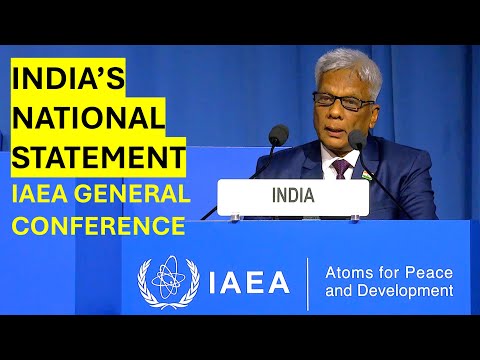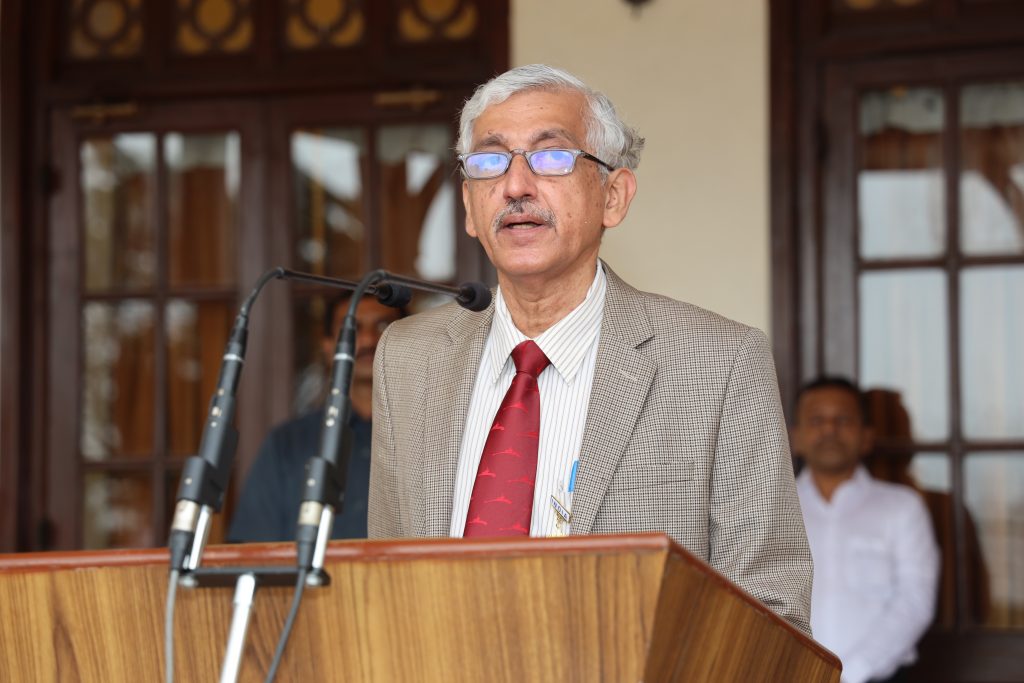



Mr. President,
Kindly accept congratulations on behalf of my Government and my own behalf on your election as President of the 49th General Conference. I am sure, under your able leadership and with the support of your team and the Secretariat of the Agency, this General Conference will be able to accomplish the tasks before it.
I take this opportunity to welcome the entry of Belize to the membership of the IAEA.
Let me also use this occasion to once again congratulate Dr. Mohamed ElBaradei on his re-appointment as Director-General, IAEA for another term. We wish him all success and as in the past, we will continue to work in close cooperation with him in achieving our collective objectives in accordance with the statute of the Agency.
Mr. President, the issues related to global climate change, sustainability of energy resources while meeting the ever increasing energy needs to support economic development and concerns regarding escalating trends in fuel prices, point to the inevitability of nuclear power. Global nuclear renaissance is now a reality.
India which constitutes one-sixth of the global population is on the rapid economic growth path. A recent study has revealed that we will need to augment our electricity generation nearly ten-fold in next four to five decades. This would be a significant fraction of global electricity generation. A large fraction of this energy coming from nuclear power would be of immense benefit, in the context of environment and sustainability concerns, for India as well as for the rest of the world. Nuclear energy is thus an important and inevitable option for India. As a part of realizing this objective, we have been pursuing a self-reliant indigenous nuclear power programme. This programme is tuned to realize our long-term energy requirements utilizing our vast thorium resources. This is of crucial importance to us as our uranium resources are modest. In this context, let me quote from the statement of our Prime Minister made in our Parliament on 29th July, 2005 "Our nuclear programme in many ways is unique. It encompasses the complete range of activities that characterise an advanced nuclear power including generation of electricity, advanced research and development and our strategic programme. Our scientists have mastered the complete nuclear fuel cycle. The manner of the development of our programme which has been envisaged is predicated on our modest uranium resources and vast reserves of thorium. While the energy potential available in these resources is immense, we remain committed to the three-stage nuclear power programme, consisting of Pressurised Heavy Water Reactors (PHWRs) in the first stage, fast breeder reactors in the second stage and thorium reactors in the third stage. These would need sequential implementation in an integrated manner. Our scientists have done excellent work and we are progressing well on this programme as per the original vision outlined by Pandit Jawaharlal Nehru and Dr. Homi Bhabha. We will build on this precious heritage.
Energy is a crucial input to propel our economic growth. We have assessed our long-term energy resources and it is clear that nuclear power has to play an increasing role in our electricity generation plans. While our indigenous nuclear power programme based on domestic resources and national technological capabilities would continue to grow, there is clearly an urgent necessity for us to enhance nuclear power production rapidly. Our desire is to attain energy security to enable us to leapfrog stages of economic development obtained at the least possible cost. For this purpose, it would be very useful if we can access nuclear fuel as well as nuclear reactors from the international market. Presently, this is not possible because of the nuclear technology restrictive regimes that operate around us."
While addressing at the Golden Jubilee Function of the Department of Atomic Energy (DAE) and the launch of construction of the Prototype Fast Breeder Reactor (PFBR) at Kalpakkam on 23rd October, 2004, our Prime Minister had said:
"India is a responsible nuclear power. We are fully conscious of the immense responsibilities that come with the possession of advanced technologies, both civilian and strategic. While we are determined to utilize our indigenous resources and capabilities to fulfill our national interests, we are doing so in a manner that is not contrary to the larger goals of nuclear nonproliferation.
India will not be the source of proliferation of sensitive technologies. We will also ensure the safeguarding of those technologies that we already possess. We will remain faithful to this approach, as we have been for the last several decades. We have done so despite the well-known glaring examples of proliferation, which have directly affected our security interests.
The limitations of the present non-proliferation regime should not be further accentuated by artificial restrictions on genuine peaceful nuclear applications. Technology denial and closing avenues for international cooperation in such an important field is tantamount to the denial of developmental benefits to millions of people, whose lives can be transformed by the utilization of nuclear energy and relevant technologies.
We call upon other advanced nuclear powers, and all those who have a stake in the future of nuclear energy, to come together for a constructive dialogue to evolve more effective measures that would stem the tide of proliferation without unduly constraining the peaceful uses of nuclear energy. Constraining those who are responsible, amounts, in effect, to rewarding those who are irresponsible. The international community must face up to the implications of this choice. We in India are willing to shoulder our share of international obligations provided our legitimate interests are met. India has actively embraced globalisation. There is no reason why nuclear energy production should be an exception."
We are happy that we are now feeling the winds of change. We welcome the statements of USA and France on this podium and the positive and cooperative approach of several key countries in this regard. We look forward to a rapid growth in nuclear power generation capacity in India based on full international civilian nuclear cooperation as we continue our efforts to develop appropriate indigenous technologies towards realization of the ultimate goal of large-scale utilization of thorium for energy production not only in the form of electricity but also as hydrogen. We expect that the unique case of India as a responsible country with advanced nuclear technologies developed in a self-reliant manner, its large-scale energy requirements which have ramifications in terms of protecting the global climate, ensuring sustainability of energy resources and restraining escalating spiral of fuel prices, its impeccable record in terms of non-proliferation of WMD & related technologies and adherence to all its international commitments would soon result in lifting of all restrictions on India. Predicated on our obtaining the same benefits and advantages as other nuclear powers, consistent with our national policy of maintaining the integrity of our three stage nuclear energy programme, and ensuring full autonomy of our nuclear programme of strategic and R&D significance, India would be prepared to take reciprocal steps in a phased manner in keeping with the responsibilities and obligations of an advanced nuclear power with the objective of full civilian nuclear energy cooperation with international partners. Since some of these steps will also include safeguards on facilities of a civilian nature, selected by India on a voluntary basis, we will, at the appropriate stage, approach the IAEA in this regard.
Mr. President, we would like to see a rapid increase in nuclear power generation capacity in India well above the planned programme of achieving 20,000 MWe by the year 2020. This capacity could consist of imported Light Water Reactors (LWRs) which run on imported fuel, domestic Pressurised Heavy Water Reactors (PHWRs) which run on imported fuel, domestic PHWRs which run on domestic fuel and Fast Breeder Reactors. Progressively power reactors running on thorium would get added to this list.
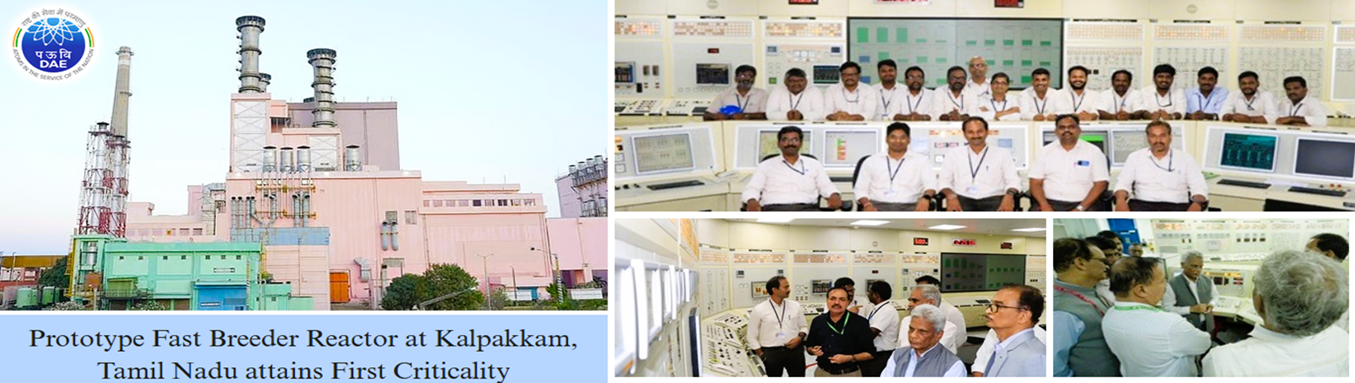
Let me now report some of the recent developments in India. With the PHWR programme well on its growth path and having established comprehensive expertise in Fast Breeder Reactor (FBR) Technology, we have now embarked on the development of FBR - based second stage of our programme with the start of construction of the 500 MWe Prototype Fast Breeder Reactor launched in October last year. Our studies indicate that we should be in a position to support around 500 GWe power generation capacity based on FBRs with plutonium bred from indigenously available uranium. We are certain that Fast Breeder Reactors by virtue of their crucial place in sustainable development of nuclear energy would come centrestage worldwide in a couple of decades. The first 540 MWe PHWR unit at Tarapur has commenced commercial operations about 7 months ahead of schedule. Unit - 1 of Kakrapar Atomic Power Station has been operating continuously for more than a year. This is an Indian record. The indigenously developed unique Pu-rich mixed carbide fuel used in the Fast Breeder Test Reactor (FBTR) has performed extremely well crossing a burn-up of 148,000 MWd/t, without a single fuel pin failure. One of the important achievements during the year was closing of the fuel cycle of FBTR. The FBTR fuel discharged at 100,000 MWd/t has been successfully reprocessed. This is the first time that the Plutonium - rich carbide fuel has been reprocessed anywhere in the world. As a part of development of higher burn-up fuel for PHWRs 25 MOX bundles were successfully irradiated to a target burn-up of about 11,000 MWd/T. This year we have introduced additional 25 MOX fuel bundles in one of our PHWRs.
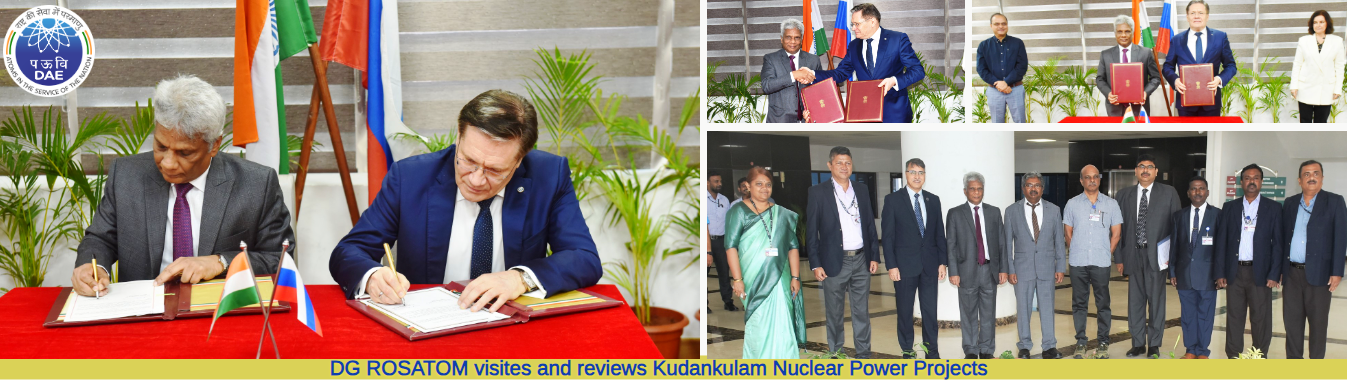
Construction of five PHWRs is progressing on schedule. These along with the two 1000 MWe VVERs presently under construction at Kudankulam in collaboration with Russian Federation would contribute 3420 MWe additional carbon-free electricity to the Indian grids in about 3 years time.
We have taken up development of sites for new nuclear power units and have commenced work to identify additional sites for further expansion of the programme.
The design of Advanced Heavy Water Reactor, an innovative Indian design aimed at moving further on thorium utilization route is under regulatory review. We intend to proceed further to take up its construction after the review process is completed. Work on development of a Compact High Temperature Reactor with the aim of producing hydrogen, which could be the most important energy carrier in the future as well as development of Accelerator Driven Systems that could sustain growth with thorium systems and enable incineration of long lived radioactive wastes is progressing well. The development of laser-based Uranium-233 clean up system, a crucial element in thorium utilization programme has made significant progress. The Steady State Superconducting Tokamak - SST-1 would soon see the first plasma shot. We are looking forward to joining the ITER project as a full partner.
The safety record of our nuclear and radiation facilities continues to be excellent. During 2004, we had only 1 event at level-2 and 4 events at level-1 of the International Nuclear Event Scale (INES).
En masse coolant channel replacement and other safety upgradation jobs in the Madras Atomic Power Station Unit-1 are nearing completion and the Unit is expected to be back in operation before the end of this year. A comprehensive safety review of the Tarapur Atomic Power Station which is in operation since 1969 has been completed by our regulatory body and implementation of the identified ageing management and safety upgradation jobs will be taken up shortly.
On 26 December 2004, the Eastern and Southern coasts of India were hit by a tsunami. Unit-2 of the Madras Atomic Power Station which was in operation at this time experienced minor flooding in its sea water pump house due to tsunami - induced surges and was shut-down. Apart from this, there was no other impact on the plant and the Unit could be brought back to operation within one week after review of the incident and clearance by the regulatory body. The excavated pit at the Prototype Fast Breeder Reactor construction site got flooded due to sea water ingress on account of the tsunami. The pit was dewatered and cleaned and, after incorporating necessary corrective measures, construction work has been resumed. The tsunami did not have any impact on the construction site of the two VVER-1000 NPPs.
In the area of accelerators and lasers, the second Indian Storage Ring, the 2.5 GeV Synchrotron Radiation Source - Indus-2, has been fully assembled and integrated. All sub-systems have been made operational and initial experiments to store 600 MeV electron beam in the ring have been commenced. Laser - based coolant channel cutting technology has been developed and successfully tested on one of the channels in a PHWR. This development will greatly bring down the man-rem consumption during the planned en masse coolant channel replacement work in the Narora Atomic Power Station reactors.
There has been a steady progress in expanding the benefits of atomic energy for the society. Several radiation processing plants based on Cobalt-60 are under construction in private and cooperative sectors. Demonstration facilities for radiation processing of food and materials using electron beam accelerators are also in advanced stage of construction. An Advanced Centre for Treatment, Research and Education in cancer (ACTREC) has been set up with the specific mandate to undertake on mission-oriented basis applied and translational research on cancer prevalent in Indian subcontinent. It will also apply cutting edge technologies in the treatment of cancer in partnership with industry and leading institutions in India and abroad and conduct educational programmes and undertake human resource development in different disciplines of oncology. To meet the growing demand of Teletherapy machines to combat cancer, an indigenously designed and developed state of art Co-60 Teletherapy machine - BHABHATRON has been commissioned. We feel this product would be very useful for fighting cancer in the developing world. Indian experts are actively involved in the Agency's "Programme of Action for Cancer Therapy" (PACT).
The International Atomic Energy Agency is playing a vital role in the peaceful uses of nuclear science and technology in a safe and secure manner. As in the past, we have been working in close partnership with the Agency. Our experts are involved actively in the Agency's international project on Innovative Nuclear Reactors and Fuel Cycles (INPRO). India has committed itself to carry out an INPRO Joint Study for an assessment of an innovative nuclear energy system based on high temperature reactors for the production of hydrogen using the INPRO methodology. As a part of the INPRO programme, India is also participating in the joint study on Innovative Nuclear Fuel Cycles based on Fast Reactors with closed fuel cycles. We look forward to the initiation of phase - 2 of INPRO.
In the area of knowledge management, our experts take active part in the Agency's programme such as Asian Network for Higher Education in Nuclear Technology (ANENT) and in the recently conducted WNU's first Summer Institute of Fellows having an intense 6-week educational experience featuring some of the international community's foremost leaders in science, engineering and environment.
Nuclear technology is knowledge intensive. Development of individuals is central to knowledge management. Nuclear industry needs well-trained human resources and strong industrial infrastructure for its exploitation. High importance has been given to Human Resource Development, right from the beginning of our programme. Recently our Prime Minister has announced the setting up of Homi Bhabha National Institute as a Deemed University to provide a platform for accelerating the pace of basic research as well as translation of basic research into development of advanced nuclear technologies.
We attach great importance to the Technical Cooperation Programme of the Agency. As in the past, we have pledged and paid our contribution to Technical Cooperation Fund in full and in time. In the year 2000, the Department of Atomic Energy had entered into a Memorandum of Understanding with the IAEA to further strengthen cooperation with the Agency covering Fellowship Training, Scientific Visits and Expert Services. An agreement was signed last month for streamlining the procedures for activities covered by this MoU. In the area of nuclear safety and security, India ratified the Convention on Nuclear Safety and participated in the third review meeting of the contracting parties held in April as an Observer. We also took active part in the amendment process to the Convention on Physical Protection of Nuclear Materials.
India, United States and IAEA have established a Regional Radiological Security Partnership programme (RRSP). Under this framework, India offered to provide infrastructure and expertise on a regular basis for conducting International Training Courses in India under the aegis of IAEA, on issues related to the Security of Radioactive Sources and materials as also for locating Orphan Radioactive Sources in countries which are unable to effectively deal with them and which seek assistance from the IAEA. Like in the past few years, India will be conducting the Regional Training Course on Physical Protection of Nuclear Installations during Nov. 7-18, 2005 in Mumbai.
Last month, a five-day international Workshop on external flooding hazards at Nuclear Power Plant Sites was organized at Kalpakkam. The Workshop provided the opportunity for experts to exchange experience and knowledge related to flooding hazards at NPP sites arising from various causes including tsunamis.
Mr. President, before I conclude, it is worthwhile for us to remind ourselves on the eve of the Golden Jubilee year of the Agency, that the IAEA is the world's center of cooperation in the nuclear field and was set up as the world's "Atoms for Peace" organization within the United Nations family. The Agency has well established mechanisms to realise the full potential of atoms for sustainable development. With the huge development deficit that still exists, sustainable development is crucially dependent on the enormous power of atom. The challenge before us is to channelise this enormous potential to world peace and prosperity while preventing its destructive use by irresponsible state and non-state actors. Addressing this challenge successfully would change the perception of the Agency from just a 'nuclear watchdog' to a 'nuclear Kamadhenu', the Indian mythological cow, that symbolises an inexhaustible sustenance provider for the welfare of the humanity. Once we realise this, a good part of cause for conflict should vanish. We thus have a unique opportunity here at IAEA to make a lasting contribution to world peace. We owe this to this unique multi-disciplinary organisation and in fact the entire UN system.
Thank you, Mr. President.
********************