





Homi Jehangir Bhabha (1909-1966)
BACK

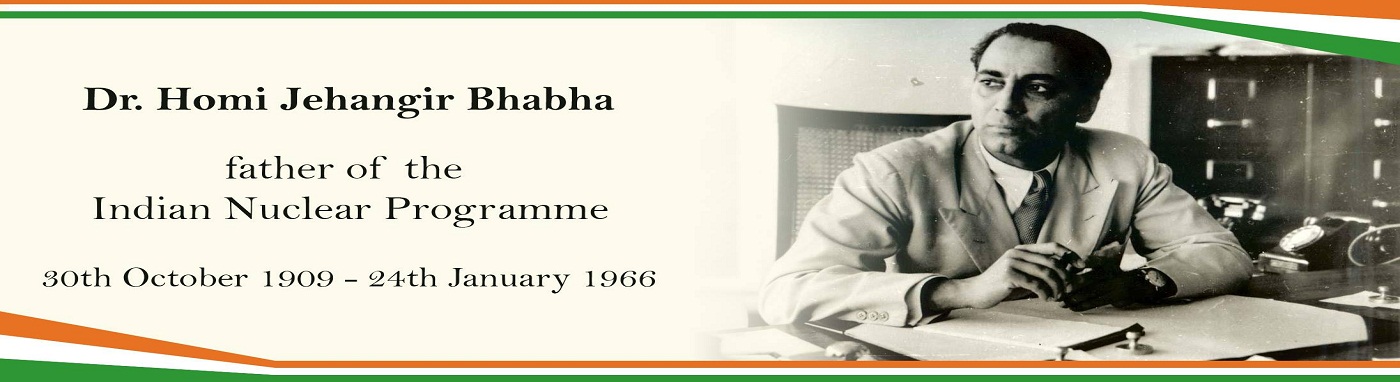
Homi Jehangir Bhabha is the acknowledged founder and prime architect of the Indian Atomic Energy programme. The beginnings of this programme have been often traced to a bold initiative that Bhabha had taken in 1944, in addressing a letter to the Sir Dorabji Tata Trust proposing the foundation of an Institute devoted to Fundamental Research in some of the emerging areas in physics - which in the course of time could develop into a school of physics comparable to the best in the world. This Institute, which was named as the Tata Institute of Fundamental Research (TIFR), became the nursery for ‘growing’ the Atomic Energy Programme in the early years, and for building a team of experts. In fact, in that same letter of 1944, Bhabha had made the prophetic observation that "when nuclear energy has been successfully applied for power production, in say a couple of decades from now, India will not have to look abroad for its experts but will find them ready at home".

1944 was still one year before the world came to know of the ‘awesome’ potential of nuclear energy. The attainment of political independence and freedom from colonial rule was still some three years away. Except for one large integrated steel plant (the Tata Iron and Steel Company at Jamshedpur), and a few hydroelectric power stations (in the old Presidencies of Bombay and Madras), the demonstrated industrial or technological capability in the country was very little. In such a setting, where from did Bhabha derive his inspiration and confidence for launching a large programme in an advanced field of science and technology? To some extent the answers can be found in Bhabha’s early up-bringing in the cosmopolitan city of Bombay, and his later exposure to Western science, in the laboratories at Cambridge, in the United Kingdom, during the years 1927-1939, when epoch-making discoveries were being made, unravelling the sub-structure of the atomic nucleus, in course of time leading to the discovery of the fission of the uranium nucleus.

Bhabha belonged to an illustrious family with a long tradition of learning and service to the country. The family, both on his father’s and his mother’s side was close to the house of Tatas, who had pioneered projects in the fields of metallurgy, power generation, and science and engineering education, in the early part of the Twentieth century. The family was imbued with a strong nationalistic spirit, under the influence of Mahatma Gandhi and the Nehru family. The family also had cultivated interests in the fine arts - particularly Western classical music, and painting - that aroused Bhabha’s aesthetic sensibilities, and remained as a dominant influence in all the creative work he undertook during his life time.

After passing his Senior Cambridge Leaving Examination (at the Cathedral High School in Bombay), Bhabha proceeded to England, in 1927, to join the Caius College in Cambridge to study engineering, but his heart was really in physics. And so, immediately after passing the Mechanical Sciences Tripos in 1930, he switched over to research in theoretical physics. During the period 1930-1939, Bhabha carried out outstanding original research relating to cosmic radiation, coming up with observations on the production of electron pairs in the interaction of cosmic radiation with matter, and also identifying muons - heavier than electron particles - as present in the penetrating component of cosmic rays. All this earned for him his election to the prestigious Fellowship of the Royal Society in 1940, at the young age of 31. During this period, Bhabha not only developed strong friendship with the scientists working in Rutherford’s Laboratory, including John Cockroft, Paul Dirac and W.B.Lewis, but also spent time with other leading physicists like Niels Bohr (in Copenhagen), Wolfgang Pauli (in Zurich), and Enrico Fermi (in Rome) - friendship that abided in the later years, when he started organising the programme in India.

Bhabha returned to India in 1939, and had to stay back on account of the out-break of the second world war. He elected to work at the Indian Institute of Science, Bangalore, where C.V.Raman, India’s first Nobel Laureate in Science, was at the time Head of the Department of Physics. Initially appointed as a Reader, Bhabha was soon designated as Professor of Cosmic Ray Research. Apart from taking up experimental work in cosmic rays, Bhabha also pursued his natural interests in mathematics. And it was from Bangalore that Bhabha wrote that letter of 1944.

Bhabha’s leadership of the atomic energy programme spanned 22 years, from 1944 till 1966. The Tata Institute of Fundamental Research was formally inaugurated in December 1945 in ‘Kenilworth’ building, which was Bhabha’s ancestral home. During the period 1945 to 1954, the work of TIFR proceeded in temporary buildings in Bombay and covered the fields of nuclear physics and electronic instrumentation, in addition to cosmic ray experiments. Work on the permanent buildings for the Institute was commenced in 1954, with Pandit Jawaharlal Nehru laying the foundation stone, and was completed in 1962. In addition to his zeal for advanced science, Bhabha paid great attention to all aspects of aesthetic design, in the implementation of the programme in the different parts of the country. In particular, the TIFR is a magnificent edifice - surrounded by beautiful lawns and gardens - that stands out as a thing of great beauty, at Land’s End, in Bombay, facing the Arabian Sea.

(Source : Atomic Energy in India : 50 years by C. V. Sundaram et.al)

Back