


NOTE: This version (HTML) contains only the Exceutive summary of the
Annual report. Click here to continue to read this version.
Full report is available
in Adobe acrobat format click here
(requires Adobe Acrobat Reader. If you do not have it
)
(Please note that the file sizes are large ranging from 200 - 450 kbytes)
|
Department of Atomic Energy 2001 - 2002 |
![]() |
![]() |
![]() |
![]() |
![]() |
![]() |
![]() |
![]() |
![]() |
![]() |
![]() |
![]() |
| The cover shows
(rowise) some of the achievements of DAE during the IX Plan period (1997-2002):
l Rajasthan Atomic Power Station-3&4, Rawatbhata (Rajasthan); Kaiga Atomic Power Station 1&2, Kaiga (Karnataka); Research reactor KAMINI, Kalpakkam, (Tamil Nadu) l Narwapahar Uranium Mine (Jharkhand), New Uranium Fuel Assembly Plant , Nuclear Fuel Complex,(Hyderabad), Kalpakkam Reprocessing Plant, Kalpakkam, (Tamil Nadu) l Solid Storage Surveillance Facility at Tarapur (Maharashtra), Spice Plant at Vashi, Navi Mumbai, Synchrotron Radiation Source Indus-1, Indore (Madhya Pradesh) l Laser equipment for treatment of oral cancer, developed at CAT, Giant Metrewave Radio Telescope (GMRT) set up by TIFR , near Pune, (Maharashtra), ADITYA Tokamak at IPR, Ahmedabad (Gujarat |
Executive Summary
During the year 2001-2002, all the organizations of the DAE family performed well with marked growth trends.
The performance and safety record of the operating nuclear power stations,
heavy water plants and other industrial units and facilities, were excellent.
The Nuclear Power Corporation of India Ltd. (NPCIL) generated over
19,000 million units of electricity during the calendar year 2001, which
is much higher than the target.
For excellence in performance, safety and environment conservation,
a number of awards were bagged by the Heavy Water Plants.
NFC achieved highest production of natural uranium oxide fuel
bundles, so far.
The reprocessing plants at Trombay, Tarapur and Kalpakkarn continued
to operate satisfactorily and the waste management facilities at
Trombay, Tarapur, Rajasthan and Kalpakkam operated regularly.
Releases from all the DAE+IBk-s installations were meeting the national and international standards.
For sound environmental management system, four of the atomic power stations and one heavy water plant were given certification as per ISO 14001.
At IGCAR, the indigenously developed mixed carbide fuel reached a record burn-up of 87,650 megawatt day/ton
At Trombay, the design of fuel, reactor components and major process systems of Advanced Heavy Water Reactor (AHWR) were completed.
The research centres, viz. BARC and IGCAR provided research and development support to the Indian nuclear power programme. R&D efforts of BARC were focused on coolant channel life management and repair technologies.
The exploration and evaluation drilling by AMD resulted in estimation of additional uranium resources
The research reactors Dhruva and Apsara continued to perform well. During 2001-2002, supply of about 40,000 consignments of radioisotopes and allied products valued at about Rs.19 crore is expected by BRIT.
ISOMED plant continued to offer gamma sterilization of medical products.
At Trombay, development of large seeded groundnuts, obtained by combining several radiation induced mutants, was a major achievement of mutation technology.
Clearance for radiation processing of sea foods and pulses for domestic consumption and export, was received from the Government.
For marketing radiation processed spices in Maharashtra, BRIT entered into marketing arrangement with a women+IBk-s cooperative society.
For the financial year 2000-2001, the Indian Rare Earths Ltd. (IREL) registered record turnover, earned Rs. 100 crores by way of exports, and paid maiden dividend of Rs. 3.34 crore to the Government.
The Uranium Corporation of India Ltd. (UCIL) recorded satisfactory production. The Electronics Corporation of India Ltd. (ECIL) also posted an impressive performance, and its new products introduced in the market received good response from strategic sector.
Following is the summary of the activities of the DAE organizations given in the chapters ahead in this report :
Nuclear Power Programme
With a total installed capacity of 2720 MWe, NPCIL has been operating 14 atomic power reactors +IBQ- 2 boiling water reactors (BWR) and 12 pressurised heavy water reactors (PHWR).
Since commencement of their commercial operation till end of January, 2002, about 168 billion units were generated by the operating atomic power plants of NPCIL, and 11.1 billion units were generated by RAPS-1 (owned by DAE). Operating performance of NPCIL+IBk-s atomic power plants improved from an overall annual capacity factor of 71% in 1997-98 to 82.8% upto January, 2002. During the calendar year 2001, NPCIL achieved 83% capacity factor registering gross generation of 19,085 million units during the calendar year 2001.
NPCIL has been setting up 2x540MWe PHWR Tarapur Atomic Power Project-3&4 (TAPP-3&4) in Maharashtra, 2x1000 MWe light water reactor (Russian VVER) Kudankulam Atomic Power Project (KK-1&2) in Tamil Nadu, and 2x220 MWe PHWR each at Kaiga (Kaiga-3&4) in Karnataka and Rawatbhata (RAPP-5&6) in Rajasthan.
The 540 MWe PHWR is based on the design and technology developed indigenously
and the 220MWe PHWR is the reactor design standardized in India.
During the period of report, construction of the TAPP-3&4, achieved
an overall physical progress of about 40%. The Detailed Project Report
(DPR) for setting up KK-1&2 was completed and pre-project activities
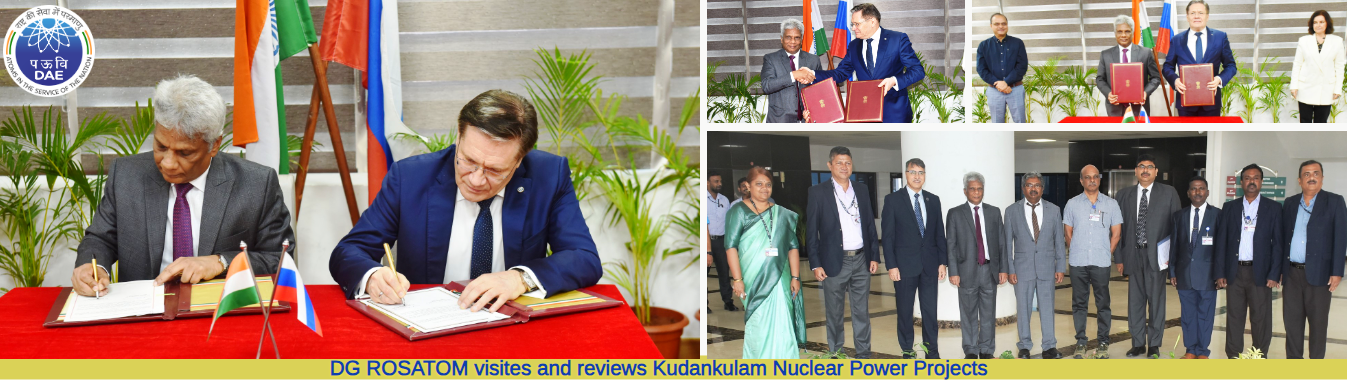
at the project site continued. MoU was signed between DAE and the Ministry
of Atomic Energy (MINATOM) of Russian Federation, on November 6, 2001.
Construction for setting up Kaiga-3&4 commenced and excavation work
of the main plant buildings reached completion. Pre-project
activities for RAPP-5&6 also commenced.
NPCIL registered a profit-before-tax of Rs. 932 crore (Provisional) up to December 2001, and paid Rs. 76.84 crore as dividend to the Government of India for the financial year 2000-2001. This is the fourth consecutive year for which dividend has been paid by NPCIL.
Fast Breeder Programme
FBTR at IGCAR, is the first fast reactor of its kind in the world
that uses plutonium uranium mixed carbide fuel.
The Mark-I core of Fast Breeder Test Reactor (FBTR) reached a burn-up
of 87,650 megawatt day/ton. Fabrication of Mark-II core progressed well.
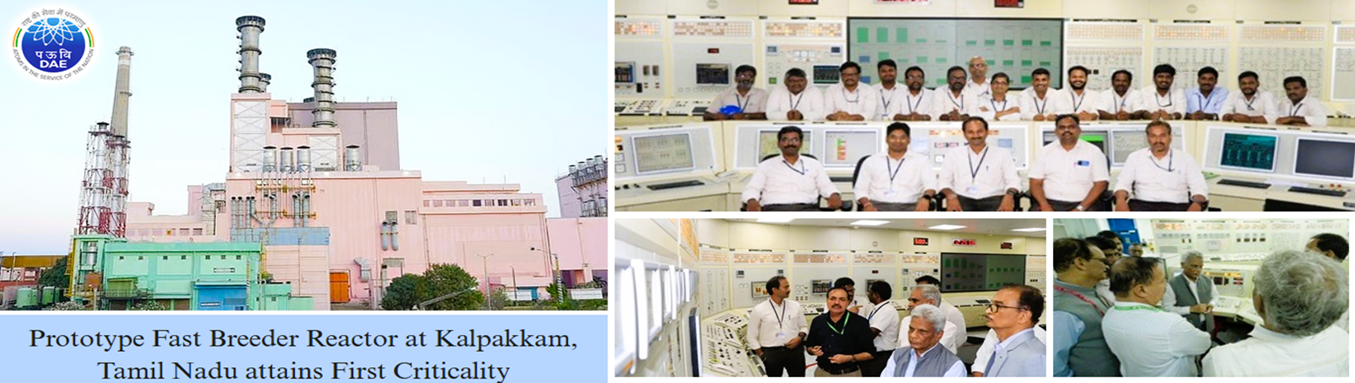
The design of 500 MWe sodium cooled pool type Prototype Fast Breeder Reactor
(PFBR) approached completion. Construction of PFBR will commence soon.
Thorium Utilisation Programme
India has vast reserves of thorium.Thorium when irradiated, gets converted to nuclear fuel uranium-233 which can be used for power generation. Towards use of thorium for power generation, BARC has been developing Advanced Heavy Water Reactor (AHWR).
At BARC, the design of fuel, reactor components and major process systems of AHWR were completed.
Construction work on Critical Facility for reactor physics experiment for AHWR, and 500 MWe PHWRs commenced and the road map for development of all the technologies involved in Accelerator Driven Sub-critical System (ADS) was finalized.
R&D Support to Power Programme
The research centres, mainly BARC and IGCAR provide R&D support
to the Indian nuclear power programme.
R&D efforts of BARC were focused on coolant channel life management
and repair technologies. Fuel Handling Control Training Simulator for Kaiga,
two Fuelling Machine heads for Kaiga and RAPS 3 & 4, and a miniature
CCTV camera for visual inspection of pressure tubes were developed. A remotely
operable special machine (Guide Sleeve Cutting Machine) was developed to
cut the guide sleeve of the power reactor fuelling machine in emergency
situation.
Using carbon dioxide laser, CAT has developed stellite overlay on ANSI 304 SS with graded composition. For potential application in decontamination and decommissioning of nuclear reactors, studies on scabbling, glazing and drilling of concrete blocks with high power carbon dioxide laser were carried out.
Nuclear Fuel Cycle
Nuclear power generation is supported by the Nuclear Fuel Cycle Programme which circumscribes mining, milling and ore processing, fabrication of nuclear fuel, reprocessing of used nuclear fuel, and nuclear waste management operations. For PHWR technology for power generation, production of heavy water is also a programme ancillary to nuclear power generation. In all these programme segments, DAE has acquired full indigenous capability.
Mineral Exploration
Surveys, prospecting and exploration of uranium, thorium, rare metals
and rare earths, titanium and zirconium mineral resources are done by the
Atomic Minerals Directorate for Exploration and Research (AMD).
The exploration and evaluation drilling by AMD resulted in estimation
of additional uranium resources at Wahkyn (Meghalaya), Rohil-Ghateshwar
(Rajasthan) and Gogi (Karnataka). Significant uranium mineralisation
was located in parts of Cuddapah district (Andhra Pradesh), West
Khasi Hills district (Meghalaya),Gwalior district (Madhya Pradesh)
and Bargarh district (Orissa).
Airborne gamma ray spectrometric and aero-magnetic surveys were carried
out over 16,200 line km over parts of Satpura Gondwana (Madhya Pradesh)
and Sakoli Group of rocks (Maharashtra).
New heavy mineral zones were identified along Avudaiyarpuram
& Idindakarai river mouths (Tamil Nadu); Kanthi coast (West Bengal)
and Baulapore & Ramnagar in Mahanadi delta & Puri - Brahmagiri
coast (Orissa). Additional reserves of columbite-tantalite were estimated
in parts of Orissa, Jharkhand and Chhattisgarh.
Mining
The exploratory efforts of AMD made in the past, have led to the opening
of uranium mines at Jaduguda, Bhatin and Narwapahar (all in Jharkhand),
and sand mineral ores.
Mining and processing of uranium ores and mineral sands are respectively
carried out by the public sector undertakings, the Uranium Corporation
of India Ltd. (UCIL) and Indian Rare Earths Ltd. (IREL). The performance
details of both these companies have been given in the following text.
Heavy Water Production
The Heavy Water Board operates seven heavy water plants and has achieved self-sufficiency in the production of heavy water.
The performance and safety record of all the operating heavy water plants were excellent. The production of heavy water is expected to exceed the targeted production during the period of report.
The multi-pronged efforts of HWB resulted in continuous downward trend in the specific energy consumption during the last three years. During the current year, further reduction of about 4.5% in specific energy consumption was achieved.
Project on Revival of HWP-Baroda received clearance from the Gujarat State Pollution Control Board for Ammonia Water Front-End Technology
Demonstration Plant. At Talcher, the R&D Pilot Production Facility for manufacture of chemical D2EHPA (di 2 ethyl hexyl phosphoric acid), continued to operate successfully. Work commenced on setting up 60 metric tonnes/year plant at Talcher for production of Tributyl Phosphate.
Fuel Fabrication and Development
Fabrication of fuel bundles for power reactors is done by the
Nuclear Fuel Complex (NFC), Hyderabad. NFC also manufactures seamless
stainless steel and alloy steel tubes for various engineering industries
as well as ultra-pure materials for electronic industry. Under its import
substitution efforts, NFC has successfully built sophisticated machines
for in-house use. It is also engaged in the development of components
for advanced reactors such as PFBR
NFC achieved highest production of natural uranium oxide fuel bundles
so far, which was 12% higher than the target set for the year 2001-2002.
Also, the hafnium free zirconium oxide powder and reactor grade zirconium
sponge productions far exceeded the targets.
The projects +IBw-Advanced Materials and Characterisation Facilities+IB0-,
+IBw-Replacement & Augmentation of Zirconium Sponge Plant+IB0-, +IBw-37 Element
Fuel Assembly Project+IB0- and +IBw-Pilot Plant for Development of Pyro-chemical
Process, made progress.
NFC standardized a process of appendage welding on fuel tubes which
is expected to yield better fuel performance in reactors. Also, 40 km of
heat exchanger tubes with consistent good quality, was made.
Efforts made at NFC yielded higher productivity, power specific energy
consumption, enhanced recovery and minimal down time.
Fuel Reprocessing
The reprocessing plants at Trombay, Tarapur and Kalpakkarn continued
to operate satisfactorily and supplied plutonium to meet the needs of DAE
programme. The Facility for Uranium-233 Separation (FUS) from thoria fuel
irradiated at Dhruva/Cirus reached an advanced stage of inactive
commissioning at Trombay.
At Kalpakkam, the process demonstration plant, Lead Mini Cell (LMC),
for reprocessing FBTR carbide fuel, reached advanced stage of commissioning.
The construction of Fast Reactor Fuel Reprocessing Plant (FRFRP) made progress.
Waste Management
Plants for management of all types of radioactive wastes have been in
operation at many nuclear facilities. The low and medium level radioactive
wastes are treated in eco-friendly ways. The high level wastes, generated
in very small quantities, are immobilized in glass matrix (vitrification).
Based on this technology, a Waste Immobilisation Plant (WIP) is in operation
at Tarapur and two more plants are coming up at Trombay and Kalpakkam.
The waste management facilities at Trombay, Tarapur, Rajasthan
and Kalpakkam were operated regularly. The release of activity
to the environment was maintained well within the limits prescribed by
the regulatory authorities. At Trombay, the Waste Immobilisation Plant
reached advanced stage of commissioning. At Trombay,
a process flow sheet was successfully tested, and for vitrification
of high-level liquid waste, a compact joule heated ceramic melter was commissioned
with inactive trials.
Safety & Environment
The safety operations through the entire nuclear fuel cycle, encompass all the aspects of safety viz. radiological safety, industrial safety, occupational health, fire safety and environmental protection.
In all the nuclear installations, care is taken to protect operating personnel, public and the environment. An independent body, the Atomic Energy Regulatory Board (AERB), monitors safety. The safety standards formulated by AREB are at par with those recommended by the international bodies such as the International Atomic Energy Agency (IAEA) and the International Commission on Radiological Protection (ICRP).
The environmental surveillance and monitoring programme at various nuclear sites of DAE continued. Releases from all the DAE+IBk-s installations met the national and international standards and efforts were directed towards achieving +IBg-zero discharge+IBk- level.
The epidemiological survey conducted to assess the effects of low-dose ionising radiation among the employees of the Narora Atomic Power Station at Narora (Uttar Pradesh), demonstrated that cancer prevalence in radiation workers was not different from the one seen in non-radiation workers.
For excellence in energy management, safety and environment conservation, a number of awards were bagged by the Heavy Water Plants. These included Sarvashreshtha Suraksha Award of the National Safety Council by HWP-Tuticorin; National Energy Conservation Award-2001 of the Energy Management Centre, Ministry of Power, and Golden Peacock Environmental Management Award-2001 of the World Envirionmantal Foundation, and Industrial Safety Award-2000 of AERB, by HWP-Kota; Fire Safety Award of AERB and Greentech Environmental Excellence Award of the Greentech Foundation by HWP-Manuguru, and Green Site Award of AERB by HWP-Thal.
At IGCAR, a Personnel Monitoring Facility was granted accreditation
certificate by AERB; A new shielded chair counter facility for whole body
monitoring was installed; about 500 occupational workers from various facilities
of the centre were monitored for internal contamination, and over 14200
TLD cards were read.
The facilities of IGCAR and BARC at Kalpakkam, carried out safety surveillance
activities to ensure safe work environment, and conducted training programmes
on safety, fire and first aid.
The atomic power stations at Tarapur, Narora, Kakrapar and Kalpakkam
obtained the Environmental Management System (EMS) certification as per
ISO-14001.
HWP-Manuguru obtained ISO-14001 environmental management system certificates.
Work on implementation of ISO-14001 in respect of HWP-Kota progressed well.
For NFC, validity of ISO-9002 certificate was upheld and efforts were
initiated for ISO-14001-EMS and six-sigma quality in operations.
Quality Assurance
QA Directorate of NPCIL was re-certified for ISO 9000 on its re-audit
during the year 2001. Concrete Technology Laboratory at TAPP-3&4 was
certified for ISO 9001 certification.
HWP-Manuguru obtained ISO-9001 quality management system. Implementation
of ISO-9001 in respect of HWP-Kota progressed well. HWP-Tuticorin started
providing consultancy services for implementation of ISO quality management
systems.
The Chavara Unit of IREL also received ISO-9002 certification.
ECIL obtained ISO-9000 certification in respect of all its product
divisions.
Radiation Technology Applications
Radiation technology finds varied applications in the fields of industry, healthcare, agriculture and research. India is a leading producer of radioisotopes in the world. Radioisotopes are produced at the research reactors Apsara, CIRUS and Dhruva at Trombay. Power reactors of NPCIL also produce cobalt-60 radioisotope. Accelerator at VECC is also used to produce radioisotopes.
Research Reactors
The research reactor programme of DAE provides R&D support to nuclear
power programme; produces radioisotopes, and provides facilities for
research.
During the year of report, the research reactors Dhruva and Apsara
continued to perform well. They were used for research and production of
radioisotopes. Refurbishing of CIRUS progressed and commissioning of its
systems was undertaken.
Medical Applications
The radioisotopes are processed and supplied by BRIT to medical users
across the country. BRIT produces and supplies radioisotope products including
radiopharmaceuticals, radiochemicals, labelled compounds, radiation sources,
gamma radiography equipment and gamma irradiators.
During 2001-2002, supply of about 40,000 consignments of radioisotopes
and allied products valued at about Rs.19 crore (as against Rs.15.25 crore
of previous year) is expected by BRIT.
BRIT produced and supplied over 1800 curies of reactor produced
radioisotopes for formulation of various radiochemicals and radiopharmaceuticals.
The first indigenous cobalt-60 teletherapy source was prepared
for use in treatment of cancer. The first Blood Irradiator, also an indigenous
product, was installed at the Kidwai Memorial Institute of Oncology (KMIO),
Bangalore, and more than 2000 blood bags were processed. A kit for the
preparation of technetium-99m MIBI, for myocardial perfusion imaging, and
Sodium Iodide capsule for the treatment of thyrotoxicosis were developed.
9000 consignments of radiopharmaceutical products were supplied by BRIT. The formulations supplied to various nuclear medicine centres included nearly 35,000 vials of cold kits and radiopharmaceutical products. Nearly 9000 kits of RIA & IRMA were supplied to 300 immunoassay laboratories in the country. Radiation sources of total activity of 771.4 kCi were fabricated and supplied to users in industry, medicine, agriculture and research fields. 114 consignments of Iridium wire were supplied for use in brachytherapy.
At Trombay , a PET (Positron Emission Tomography) systems, was under installation.
In the field of radiodiagnosis and therapy, BARC+IBk-s Radiation Medicine Centre (RMC) at Mumbai, is a premier centre in the country and is a regional referral centre of the World Health Organisation for South East Asia.
During the period of report, the centre continued with its ongoing R&D
activities in the fields of nuclear medicine and allied services, clinical
diagnosis and treatment, in-house development of radio-pharmaceuticals,
RIA technology for thyroid hormones and tubercular
antigen and antibodies etc.
Two new radiopharmaceuticals holmium-166 and samarium-153
labelled hydroxy apatite particles, for large and small joint radiation
synovectomy, were cleared for treatment of arthritis. Lutetium-177,
for palliative therapy of bone pain due to metastasis, was produced in
high specific activity. Clinical trials of hydro-gel dressings reported
satisfactory performance of hydro-gels as wound dressings.
The radioisotopes manufactured at VECC are processed for medical applications. The Regional Radiation Medicine Centre (RRMC) for meeting the requirements of the Eastern Region of the country, for radiodiagnosis and therapy.
Industrial applications
Over one million curies of cobalt-60 was recovered at RAPPCOF, the cobalt-60
handling facility at Rawatbhata (Rajasthan).
For decades, India, has been using radiation for sterilization of medical
products. BRIT+IBk-s ISOMED Plant, now having ISO-9002 accreditation, at
Trombay offers radiation sterilization facility to medical industry. ISOMED
plant continued to offer gamma sterilization of medical products. The volume
of the products processed in the plant was about 15,000 cubic
metres.
BRIT fabricated 30 units of remotely operated radiography cameras,
Roli-1 model, and supplied 14 cameras for non-destructive testing.
A light weight tungsten collimator for radiography camera and full size
model (prototype) of depleted uranium camera were also
fabricated. Five Gamma Chamber GC-900 units were refurbished
and their sources were replenished. Prototype of a new version Gamma
Chamber GC1200 was also fabricated.
2 MeV - 20 kW ILU-6 Electron Beam Accelerator was relocated and commissioned
by BARC at Navi Mumbai . This accelerator and the in-house developed
500 keV - 10 kW Electron Beam Accelerator, were extensively utilised for
industrial applications. The construction of Electron Beam (EB) Centre
at Kharghar, Navi Mumbai reached advanced stage and the development of
the accelerators progressed well.
Gamma scanning was successfully employed by BARC for trouble shooting of one 9.5m diameter column of Mangalore Petroleum Refinery Ltd., Mangalore, avoiding huge production losses due to reduced shutdown period.
At CAT, an industrial 150 W Nd:YAG laser was developed for material processing applications. This laser in conjunction with a special purpose orbital laser cutting machine, can be used for remote cutting of reactivity tubes at atomic power station. A transverse flow continuous wave 8kW carbon dioxide laser was also developed for applications such as decommissioning of nuclear reactors, deep penetration welding, cladding etc..
Research Applications
Jonaki laboratory at Hyderabad supplied 1900 consignments phosphorus-32 and and phosphorus-33 labelled nucleotides, to 35 research institutes. More than 200 (non-radioactive) custom made Oligonucleotides of varying length were supplied for genetic engineering, molecular biology work and preparation of DNA probes.
Agriculture & Food Technology
Applications of radiation technology for crop improvement and food preservation, and other areas is a continuing endeavour. Using mutation technology, 22 high yielding varieties of pulses, oilseeds, rice and jute have been produced at BARC so far.
This year, at Trombay, development of large seeded groundnuts, obtained by combining several radiation induced mutants, was a major success. This mutant has a maturity period of 120 days and large seed weight. For mass trapping of household rice weevil, a non-toxic and inexpensive technique for controlling the pest damaging stored grain, was also successfully demonstrated.
The radiation processing of food items offers several advantages over
conventional food preservation techniques. The Government of India
has approved radiation processing of certain food items both for export
and domestic consumption.
BRIT+IBk-s 30 tonne/day Spice Plant at Vashi performed well. The 10 tonne/hr
POTON Irradiator being constructed by BARC at Lasalgaon (Maharashtra),
will be commissioned shortly.
For marketing radiation processed spices in Maharashtra, BRIT entered into marketing arrangement with Annapurna Mahila Mandal -- a women+IBk-s cooperative, Mumbai. The radiation processed spices were launched in the market under the brand name +IBw-Purnanna+IB0-.
Some entrepreneurs received site clearance from AERB for location of radiation processing plants for food products in Haryana for disinfection of rice, and Maharashtra for multi-product facility to treat both medical and food products.
Clearance for radiation processing of sea foods (fresh, dried and frozen
form) and pulses for domestic consumption and export, was received from
the Government of India.
Nuclear Desalination Demonstration Plant
BARC has developed desalination technologies based on multi-stage flash (MSF) evaporation, reverse osmosis (RO) and low temperature evaporation. To demonstrate viability of coupling nuclear reactor for desalination of sea water, BARC is setting up a 6300 cubic metre/day combined MSF-RO Nuclear Desalination Demonstration Plant (NDDP) at Kalpakkam (Tamil Nadu). Construction of the plant made good progress. Its one stream is expected to be commissioned shortly.
High Technology
In the field of high technology, DAE has been focussing on the research
and development relating to lasers, accelerators, supercomputer systems,
remote handling and robotic devices, scintigraphic techniques for organ
imaging, sophisticated facilities for analysis and characterisation of
ultra-pure materials, various electronic systems and equipment, and materials.
Accelerator
DAE has established capability in design, construction and operation of particle accelerators which are used in nuclear research, isotope production and in radiation processing. The Variable Energy Cyclotron at Kolkata, 14MV Pelletron Accelerator at Mumbai, and Synchrotron Radiation Sources (SRS) Indus-I at Indore, are the major accelerator facilities in the country. The accelerators being set up are Superconducting Cyclotron by VECC (Kolkata), SRS Indus-2 by CAT (Indore), superconducting LINAC booster of the Pelletron accelerator by BARC-TIFR (Mumbai) and Electron Beam Centre by BARC (Kharghar).
At VECC, the superconducting cyclotron has reached advanced stages of
construction. The cyclotron will strengthen research in hi-tech areas.
The 450 MeV synchrotron radiation source Indus-1 at Indore, operated
satisfactorily. Of the six beamlines for Indus-1, three are now operational.
The construction of Indus-2, a 2.5 GeV electron storage ring, progressed.
For this source, several components and two beamlines were designed.
Construction of the superconducting LINAC booster of the Pelletron
accelerator at Mumbai, progressed. The boosted heavy ion beams from
the Pelletron accelerator will be used in nuclear research.
Laser Programme
The programme for development of laser technology and applications continued at CAT. A 300W Nd: YAG laser, a 2W diode pumped solid state laser, assembly of a table-top terawatt laser T3 with microprocessor based control system, and , a laser setup for laser cooling and trapping of atoms were the noteworthy developments. Work continued on the development of a 20 kW continuous wave carbon dioxide laser.
Remote Handling
At IGCAR, a number of remote handling devices were developed for inspection of reactor components. For industrial applications, a Six Axis Multi-Purpose Robot (SAMPRO), was designed and developed with the help of Indian industry. Design and development of an external Pipe inspection System (PiSys) for inspection of pipelines in power and process plants, was another salient success at Kalpakkam.
Electronics, Instrumentation and Computers
The computer based control and instrument systems, developed at Trombay, were installed and commissioned at Unit-4 of Rajasthan Atomic Power Project -3 & 4.
BARC+IBk-s 84-node Anupam supercomputer attained a sustained speed of
15 giga floating point instructions per second. Anupam series of supercomputers
have been in use in 15 organisations outside DAE. Various application specific
Intelligent Instrumentation Systems were also developed and tested. A
centralised facility for calibration of sensors, transmitters, temperature
and pressure indicators was commissioned.
IGCAR successfully miniaturized ultra-sensitive devices and developed
facilities for precise analytical work. The 3D modelling of various PFBR
components was carried out for animation of various sub-systems. A simulation
platform was commissioned at Kalpakkam for the full scope replica operator
training simulator of PFBR.
National Security
To meet the national policy of credible minimum nuclear deterrence, BARC continued implementation of necessary research and development as well as manufacturing activities.
BARC Safety Council
BARC Safety Council continued its regulatory function to ensure the safety of all the plants and facilities under its purview.
Basic & Applied Research
A monochromatic neutron beam with very sharp angular profile, was produced
and laser cooling of cesium atoms to the micro Kelvin range for high-resolution
spectroscopy, was achieved at Trombay.
The 4-element TACTIC gamma ray telescopic array was made operational
at BARC+IBk-s Grace Observatory, Mount Abu, Rajasthan.
For global monitoring and data processing, seismic facilities at Mumbai,
Gauribidanur and Delhi, continued to function satisfactorily .
At IGCAR, intensive research studies relating to high temperature superconducting
behaviour of MgB2 progressed.
Science Research Council
DAE Science Research Council, consisting of eminent scientists, has been set up to regularly peer review basic research to ensure that highest possible level of excellence is sustained.
Public Sector Undertakings
Uranium Corporation of India Ltd.
During the year 2000-2001, the turnover of UCIL stood at Rs.147.97 crore
as against the previous year+IBk-s turnover of Rs.145.33 crore. The
company made a net profit of Rs.3.04 crore.
The capacity utilization of Jaduguda Mines was 69.59% as against 77.03%
of the previous year. The work progressed on the III-stage shaft.
This year, the Narwapahar Mine achieved a higher capacity utilization at
77.03% as against 62.75% of the last year.
Indian Rare Earths Limited
For the financial year 2000-2001, IREL+IBk-s total sales turnover touched
a record figure of Rs. 259 crore +IBM- an improvement of 21% over the previous
year. Profit before tax was Rs. 48.04 crore. The export sales led to a
record foreign exchange earnings of Rs. 100 crore. The company paid a maiden
dividend of Rs. 3.34 crore to the Government. During the period April to
December 2001, the Company registered a turnover of Rs. 164.54
crore and profit of Rs. 13.24 crore.
The OSCOM unit of IREL achieved turnaround. The total ilmenite production
reached an all high of 4.2 lakh tons +IBM- an increase of 11% over
the previous year.
For financial and operational strengths, IREL, bagged the IITE Enterprise
Excellence Award-1999-2000 in the Mineral (Extraction) Industry Group.
Electronics Corporation of India
Ltd.
ECIL posted an impressive performance for the year 2000-01. The production and sales of the company were Rs. 505 crore and Rs.503 crore respectively and it earned a net profit of Rs.12 crore.
During the financial year 2001-2002, against the annual target of Rs.530 crore each for production and sales, ECIL achieved a production of Rs.341 crore and a sale of Rs.333 crore upto December 2001.
The new products of the company found wide usage in strategic and security applications. For facilitationg faster information exchange amongst the DAE units, a satellite based network (Anu-Net) was put in position.
ECIL supplied 67,000 nos. of electronic voting machines (EVMs) for elections in various states. Its efforts in this regard were highly praised by the Chief Election Commissioner of India.
During the current year (till December 2001), ECIL exports were Rs.1.18 crore.
Promotion of Research & Development
The Board of Research in Nuclear Sciences (BRNS) extended financial assistance to 58 new projects, renewed 181 ongoing projects and supported 152 symposia/conferences. The MoUs were signed for the development, production and supply of Nd-doped laser-glass for high power applications by CGCRI, Kolkata; setting up of advanced seismic test facility at SERC, Chennai, and Setting up of a National Centre for Free Radical Research at Pune. Six post-doctoral fellowships were offered under Dr. K.S. Research Associateship.
The research facilities set up at the DAE research centres and aided institutes were utilized by the researchers from universities and other institutes of the country.
The National Board for Higher Mathematics (NBHM) extended financial assistance towards library support, to 84 universities/institutions for purchase of latest mathematical books and journals, and provided an annual grant of Rs.30 lakh for Olympiad activities. In collaboration with the International Mathematical Union, NBHM initiated schemes for making mathematical literature accessible in electronic form. The Board also supported seven doctoral and six post-doctoral level fellowships.
Aided Institutions
DAE fully funds seven national institutions engaged in basic research
and education, and an educational society which manages educational facilities
for children of the employees of DAE organisations. The fund allocations
to these institutions for the financial year 2001-2002, were :
Tata Institute of Fundamental Research (Rs 90.66 crore), Tata Memorial
Centre (Rs 82.63 crore), Saha Institute of Nuclear Physics (Rs 27.93 crore),
Institute of Physics (Rs 10.22 crore), Institute for Plasma Research (Rs
46.29 crore), Harish Chandra Research Institute (Rs 7.79 crore),and Institute
of Mathematical Sciences (Rs 10.52 crore).
The major activities of the aided institutions are as follows :
At the Tata Institute of Fundamental Research, a high resolution Detector Array was set up and used for experiments with 14-UD Pelletron to study exotic nuclear properties. Over twenty five antennas of the Giant Metrewave Radio Telescope (GMRT) near Pune, were available for operations. The Homi Bhabha Centre for Science Education of TIFR, continued its programme of writing school text books. The centre organized the 33rd International Chemistry Olympiad hosted by India in July 2001.
The Tata Memorial Centre commissioned state of the art new operation
theatres. For delivering hi-tech patient care, sophisticated facilities
such as stereotactic radiosurgery and steriotactic and intensity
modulated radiotherapy, were added. An indigenous titanium humeral megaprosthesis
for shoulder was developed at the Tata Memorial Hospital which is much
cheaper than, and comparable in quality with the imported device.
The work on the Advanced Centre for Treatment, Research and Education in
Cancer (ACTREC), being set up by TMC at Owe Village, Navi Mumbai,
progressed.
At the Institute of Physics, the Ion Beam Accelerator was used by researchers
from universities and institutes. Advanced research facilities were set
up and many novel nano-materials were grown and characterized.
Research and development in fusion technology continued at the Institute for Plasma Research. Work on setting up of the superconducting steady state tokamak (SST-1), progressed.
International Research Collaboration
DAE institutes have been participating in a number of international
research programmes.
Under the DAE-CERN cooperation agreement, DAE is required to develop
and supply some of the components of the Large Hadron Collider (LHC) +IBM-
world+IBk-s largest accelerator, being built by CERN at Geneva, Switzerland.
Under the collaboration with CERN, CAT has been supplying components
for the LHC. During the period of report, CAT delived 250 super cooling
corrector magnets, precision magnets positioning jacks, 60 quench
projection heater power supplies, 8 quench protection system circuit breakers.
For CERN, BARC developed large area Silicon Strip Detectors and Quench
Protection Power Supplies along with associated electronics. In the field
of High Energy Physics, TIFR participated in the international collaborations
at CERN and Fermilab. IOP has been participating in the ALICE experiment
at LHC and STAR and PHENIX experiments at RHIC in BNL. The Institute
has been building the photon multiplicity detector (PMD) for ALICE and
STAR experiments.
Collaborative Programme
The major MoUs signed by BARC related to development of laser communicator and applications jointly with Bharat Electronics Limited (BEL), Bangalore, and collaboration in post-graduate and Ph.D. programmes in frontier areas of technology with Shreemati Nathibai Damodar Thackersey (SNDT) Women+IBk-s University, Mumbai.
BARC continued to offer for commercial exploitation, various processes and technologies to Indian industries. Work continued on setting up the Advanced Thermal Hydraulic Centre at IIT-Bombay, Mumbai.
IGCAR transferred the technology for manufacture of industrial grade hydrogen measurement system in cover gas argon and position measurement system for control & safety rod drive mechanism, to ECIL.
The HWB signed a MoU for crrying out R&D work in the field of ammonia
absorption refrigeneration system. The Board transferred the flue gas conditioning
technology to a private party, and signed a contract with the Gujarat Electricity
Board for providing a flue gas conditioning facility in their plant.
At Kalpakkam, for industrial applications, a number of innovative technologies
were developed for non-destructive testing and evaluation of materials
and components. These included welding and heat treatment procedures which
were successfully applied for the repair-welding of a closing blade of
the steam turbine of KAPS-II and emergency cooling system pump
of MAPS. Neutron radiography of pyre devices of PSLV-C3 and INSAT-3C,
manufactured by VSSC was carried out. IGCAR extended assistance to IAF
for fighter aircrafts. A residual stress measurement procedure was developed
at Kalpakkam for assessing the progress of fatigue damage towards life
estimation and extension of landing gears of fighter aircrafts. For
monitoring oxygen level in the breathing air supply system in cockpit of
light combat aircraft, a compact prototype RISK oxygen meter was developed
for DRDO.
Patents
IGCAR developed a plasma assisted metallorganic chemical vapour deposition
route and patented for chromium-nitride coatings on various substrates.
A patent-application was filed for the microwave assisted synthesis
and sintering of beta-double-prime alumina and strontium as well as barium
beta aluminas.
Human Resource Development
With a view to meet the requirements for trained engineers, a training school +IBQ- an extension of BARC Training School, was set up at NFC campus. Orientation course (OC 2001) for 25 trainee engineers was inaugurated and construction of the Residential Training School Complex (Gurukul) was commenced. Under the Indo-Vietnamese Cooperation Plan, Vietnam scientists were given training in the production of uranium fuel, zircaloy structural components and related analytical techniques.
Some major changes in the selection process for the four DAE training schools were formulated for the OCES (Orientation Course for Engineering Graduates and Science Post-Graduates) programme starting from September 2002. A web based on-line recruitment process for OCES 2002 was made operational.
The scientific officers graduating from the DAE Training School at Trombay were absorbed in DAE units. Four scientists from Vietnam, under a bilateral agreement, also joined and completed the Course.
For inducting as Scientific Officers in DAE units, 9 students were selected
under the DAE-IIT-Kanpur MTech scheme.
BARC coordinated the short term and long term training programmes and
project work of more than 1500 students from different universities across
the country and 30 trainees deputed from institutes abroad in different
divisions of BARC.
International Relations
India continued to offer training facilities, fellowships, scientific
visits, etc. to foreign scientists and provided the services of its experts
for expert assignments to other countries both through IAEA and under bilateral
agreements for cooperation in the field of peaceful uses of atomic energy.
Over 460 scientists from India participated in international symposia,
workshops, conferences and meetings.