

Indira Gandhi Centre for Atomic Research
The major achievements made by the Centre during 2000-2001 are enumerated below:
FAST REACTOR PROGRAMME
Fast Breeder Test Reactor
The Fast Breeder Test Reactor (FBTR) was in continuous operation from end October, 2000 for 52 days with the turbo-generator synchronised to the grid, which is the longest run since its first criticality. The peak burn-up of the fuel reached was about 72,000 MWd/t. The reactor generated about 6 lakh units of electrical energy.
Major surveillance activities were carried out during the planned shutdowns. Post Irradiation Examination (PIE) was done on the fuel subassembly discharged after a burn-up of 50,000 MWd/t. The results have shown excellent performance of the fuel and it was estimated that the fuel can be taken to higher burn-up. After obtaining clearance from AERB, the operation of the reactor will continue till the fuel burn-up reaches 80,000 MWd/t.
As a part of the irradiation experiment programme aimed at determining in-reactor creep rates of zirconium alloys used Pressurised Heavy WaterReactors (PHWRs), zircalloy pressurised capsules/structural material capsules irradiated in FBTR were successfully retrieved.
|
KAMINI Reactor
The reactor was operated upto 30kW (nominal power) for irradiation of specimens for experimental/forensic purposes. The Uranium-233 fuel attained burn-up of 550 MWd/t. The operations of the reactor will continue for irradiation of samples and also to carry out the neutron radiography of FBTR fuel pins.
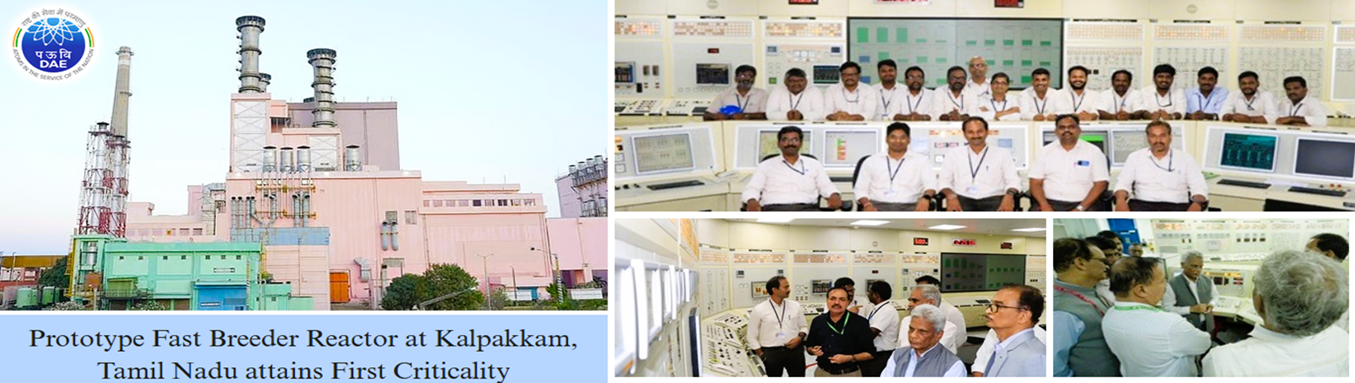
Prototype Fast Breeder Reactor
![]() |
![]() |
![]() |
|
| Overall view of Fuel Pin Bundle and (below) middle of fuel column after burn-up of 50,000 MWd/t | Upper part of Control and Safety Rod Drive Mechanism |
Clearance was obtained from AERB for setting up Prototype
Fast Breeder Reactor Kalpakkam Site. Environmental Impact Assessment Report
was prepared. Tender drawings for major Nuclear Steam Supply System (NSSS)
were completed. Manu-cturing technology for Control and Safety Rod Drive
Mechanism (CSRDM), Diverse Rod Drive Mechanism and Steam Generator (DRDM)
was completed and the components were received at site. Further progress
was made in the design of systems and components of both NSSS and Balance
of Plant. The layout of the buildings of the nuclear island and the location
of the turbo-generator building were finalised. Preliminary Safety Report
on Instrumentation & Control, Events Analysis, Quality Assurance in
design and construction were discussed with the Project Design and Safety
Committee (PDSC). Two consultants were appointed mainly for system engineering
of Balance of Plant and for the NSSS to carry out the design related to
the layout, auxiliary systems, support structures and the piping layout.
Engineering R & D
Operation of the Large Component Test Rig (LCTR), a major experimental sodium facility, continued. Exper-iments were carried out earlier to estimate the heat load to top shield, with dip seal in position. The heat transfer experiments without dip seal was carried out and heat load to top shield was estimated at different sodium temperatures. Experiments with control plug are being taken up.
For Sodium Water Reaction Test Facility (SOWART), which will be used to study the behaviour of micro-leaks of water/steam into sodium, the mechanical and electrical construction activities were completed and the instrumentation works were in progress. The set-up for the calibration of microleaks was commissioned and calibration of very small leaks was in progress.
SILVERINA, a new sodium loop for conducting various experiments and general sodium technology was commissioned. Testing of Transfer arm bearing (roller thrust type) in reactor grade sodium at 200°C was in progress. Calibration of Mutual Inductance type level probes and performance and endurance test of the electromagnet of Diverse Safety Rod Drive Mechanism (DSRDM) in sodium will be taken up shortly.
Freezing of sodium in pipes of secondary sodium circuit is necessary to operate the reactor with the defective steam generator isolated. An experiment was carried out to understand the concept of sodium freezing in large horizontal pipes. Further experiments with natural convection barrier, simulating isolation valve, were being planned.
Sodium vapour deposition studies in CSRDM model was carried out for 1500 h and 3000 h. Based on the results, suitable modification was carried out in the prototype CSRDM.
Development of mineral insulated SS sheathed expanded cold region type heaters and high watt density immersion type U heaters are required for heating of sodium circuits of fast breeder rectors. Endurance testing of two heaters at 500 deg.C was completed for 20,000 h. Around 300 such heaters were put into actual use in sodium rigs. Three indigenously designed and manufactured 20 kW capacity high watt density immersion U heaters also were also put in operation in LCTR at 500°C and have operated satisfactorily for 3,500 h.
The existing 100 cu.m/h sodium pump at high speed, with an induction motor based variable speed control system was tested successfully for its use in Steam Generator Test Facility (SGTF).
A facility for testing of CSRDM in air and in sodium at high temperatures was constructed and the testing was taken up. Testing of the prototype CSRDM with control rod in a specially erected air test facility was also completed.
The development of the hydraulics, including cavitation erosion tests, of the compact primary sodium pump was completed in collaboration with Indian Industry, through experiments on a scale model. Experiments to determine the dynamic behaviour of the primary sodium pump rotor assembly were also nearing completion.
Validation tests on slip joints required for primary and secondary sodium pumps were in progress at the Fluid Control Research Institute, Palghat.
Testing of full-scale dashpot assembly of Diverse Safety Rod Drive Mechanism (DSRDM) was completed and the design was found to be satisfactory. The load bearing capacity and response time of DSRDM electromagnet were tested and the results were satisfactory.
Transducer for the ultrasonic-under-sodium scanner for FBTR |
Development of Temperature Sensitive Magnetic Switch was in progress at IIT, Chennai. For achieving a higher operating temperature, a new ferromagnetic alloy (Fe-Ni-Co) was synthesised and a switch with the sensor part made of this alloy was tested successfully.
Cavitation experiments on dummy fuel subassembly and experiments on orifice type flow gags were completed. The labyrinth assembly required at the foot of the subassembly to reduce leakage without cavitation was designed and manufactured. Modal measurements on the instrumented dummy fuel subassembly were also completed.
Buckling of Inner vessel model under mechanical load |
Effect of rupture of an inlet pipe on flow distribution of main vessel cooling was studied experimentally on a rectangular slab model.
Manufacture of test section and the civil & structural works were in progress, for the proposed 1/4 scale reactor assembly model to study thermal, hydraulic and vibration behaviour of reactor components.
Design of a large 170 cum/h reflux type annular linear induction pump was completed, for indigenous development of electromagnetic pumps.
An improved and compact version of the ultrasonic under-sodium scanner, with piezoelectric crystal soldered to the transducer was developed for FBTR and was under performance test in sodium.
Transducers for mounting on a pipeline at a temperature up to 250 deg, C, for "clamp-on" type ultrasonic sodium flow meter were developed and the same were under testing for efficacy.
The feasibility of using ultrasound pulse-echo technique for determining the drop time of Diverse Safety Rod (DSR) was being investigated using different types of wave guides.
The software package implemented for the Operator Information System (OIS) was utilised as a part of the Distributed Control System of LCTR.
Civil works on the steam water system of Steam Generator Test Facility (SGTF) was progressing well. Design of major components in the steam water system were completed and orders placed for fabrication.Feed heaters and deaerator were received at side. The package boiler is getting ready for delivery. Fabrication of steam generator was progressing well while the boiler feed pump has been tested.
Safety report for the Isotope Separation Plant (ISP) was cleared. The commissioning procedure and operation manual were ready. The resin was charged into all the process vessels and five cycles of pretreatment were completed and the resin is kept ready for operation. The engineering experimental setup was modified and enrichment profiles were being established. Experiments were conducted in the laboratory to compare the performance of the resins.
Structural Mechanics
The buckling strength of the inner vessel of PFBR was assessed based on experiments on 1/13 models and the experimental data were predicted by detailed analysis.
Structural integrity assessment of primary sodium pipe was demon-strated experimentally including seismic event and also by finite element analysis.
The dynamic response of the core subassembly under seismic events was theoretically assessed. A row and cluster model of 7 subassemblies were tested under simulated seismic excitations to validate the computer code.
The primary containment including all the important internals were analysed for structural integrity under Core Disruptive Accident (CDA) scenario. The results were validated with tests on a 1/13 scale mode. Maximum release of sodium to Reactor Containment Building under CDA was also estimated theoretically for the determination of temperature and pressure rise.
The construction of the Structural Mechanics Laboratory was completed. The photo-elastic test facility and 200 t servo control hydraulic actuator system were commissioned.
Reactor Physics
Periodic calibration of control rods, measurement
of temperature & power coefficients of reactivity and monitoring of
reactivity loss due to burn-up were carried out for FBTR operation. Necessary
physics support was provided in the operation of KAMINI also. Safety analysis
and shielding codes & data were validated for PFBR. Probabilistic Safety
Analyses of Shutdown System and Decay Heat Removal System of PFBR were
in progress. Station blackout frequency and its duration at Kalpakkam site
was also investigated. Four sets of PFBR shielding experiments were conducted
and analysed at APSARA. For testing of PFBR fuel in FBTR, the uranium-233
requirement was optimised.
Chemical Sciences
Materials Chemistry
A sensitive analytical method was developed for determining cadmium in uranium.
Work was done on the certification of indigenous Standard Reference Material of Sea Water which is required for environmental monitoring of oceans.
For development of fast reactor fuels, calculations were performed to obtain partial pressures of uranium and plutonium bearing vapor species over uranium plutonium mixed oxide.
As a part of thermodynamic studies on fuel-clad interaction, high temperature mass spectrometric study was conducted.
Studies relating to Thermodynamic properties of sodium zirconium phosphate, which is a candidate material for radioactive waste fixation, were taken up.
Diffusion coefficient of Mang-anese-54, in D9 alloy was measured in liquid sodium. This data is useful in modelling the behaviour of radioactivity transport in reactor primary coolant circuits.
Thermal diffusivity measurements were carried out on D9 alloy, used as cladding material, over a temperature range of 600 to 1400K.
The facility for laser based mass spectrometric studies was modified to prepare thin films using Pulsed Laser Deposition method. These films have potential applications as sensors. Also thin films of vanadium pentoxide were prepared which can be used to develop bolometer.
A new method was developed for the measurement of hydrogen in metals using a polymer electrolyte based hydrogen sensor. The method was successfully applied to measure hydrogen in titanium stabilised 9Cr-1Mo steel used for steam generator. This can also be applied for measuring hydrogen in zircaloy used in PHWRs.
Fuel Chemistry
Preparation of Nuclear Fuel Materials
A laboratory scale facility was commissioned for the preparation of uranium oxide microspheres by using the sol-gel method.
A new method based on ‘de-agglomeration technique’ was developed to prepare nanophasic thoria. In addition, methods were developed to prepare high density thoria pellets at relatively low sintering temperatures.
A novel method based on microwave combustion synthesis was developed to prepare urania-ceria feed powder that could be cold compacted and sintered to high densities at relatively low temperatures.
Thermochemistry of Nuclear Materials
An experimental facility was set up for the measurement of oxygen potential of mixed oxide fuel. In order to validate the experimental method, the oxygen potential of urania was measured at various temperatures and oxygen-to-metal ratios of urania.
A new, ‘illuminated spot-technique’ with in-situ Differential Thermal Analysis (DTA) system was developed for the determination of phase transformation temperatures in alloys at temperatures below 1073 K.
Enthalpies of formation of the intermetallic compounds were determined by calorimetry. Heat capacity of thorium oxide in the temperature range of 300-800 K was also determined by using temperature modulated differential scanning calorimetry.
Post-Irradiation Examination
Burn-up of FBTR fuel was estimated. An experimental facility for the extraction and analysis of fission gas from the fuel pin was designed, fabricated and installed in one of the hot cells.
Aqueous Separations Chemistry
Kinetics of the dissolution of various thoria samples in nitric acid were studied without the addition of HF. The effect of nitric acid concentration and temperature on the dissolution rate was also studied. Exchange capacity of thorium dioxide prepared by microwave combustion synthesis was determined to get information on the presence of active hydroxyl sites.
Uranium-thorium separation was studied at various nitric acid concentrations.
The extraction of uranium and iron from nitric acid medium was carried out and extraction of uranium from tissue paper was studied.
Pyrochemical Reprocessing
Studies on the rates of conversion of UO2 and U3O8 dispersed in LiCl-KCl to UO2Cl2 by chlorination in the presence and the absence of carbon were carried out.
Instrumentation
An indigenous differential thermal analyser (DTA) capable of handling large samples (600 mg) of alkali metal was designed, fabricated and installed.
Metallurgy and Materials
Materials Technology
Colmonoy alloys were selected to replace the cobalt-based stellite alloy hardface coatings in PFBR to reduce the dose rate during handling and maintenance of various components.
Hot cracking evaluation metho-dology for austenitic stainless steel weldments was standardised.
Indigenous technology was developed for the manufacture of 16-8-2 filler wires for welding of 316LN stainless steels. A new approach was also developed for hot extrusion process for achieving better microstructural control. The process parameters for this were optimised.
Thermal aging of normalized and tempered 9Cr-1Mo steel is found to increase the threshold stress intensity factor range for fatigue crack growth at room temperature.
Dynamic elastic-plastic fracture resistance curves for AISI 308 SS weld metal were determined from instrumented impact tests on some various specimens.
Cracks in four low-pressure stage-IV steam turbine blades of KAPS Unit II were repair welded and suitably modified successfully using in-house developed procedures.
Mechanical Metallurgy
Mechanical properties of indig-enously developed Modified 9Cr-1Mo forging were characterised to assess its suitability for PFBR applications. Low Cycle Fatigue studies were conducted at different temperatures to assess the life. Creep properties of 20 % cold worked alloy D9 cladding tubes for PFBR fuel pins were evaluated at 923 and 973 K.
A new and generalised relationship was developed and validated to predict the onset of tertiary creep in stainless steel and ferritic steels.
Effects of post weld heat treatment on tensile properties of modified 9Cr-1Mo was evaluated at the temp-erature range between 300 to 873 K.
The mechanical construction of sodium loops for evaluation of creep and fatigue properties was completed. Clearance for sodium filling and isothermal run of fatigue loop was obtained.
Materials Characterisation
Intermetallic coatings for austenitic stainless steel by diffusion annealing process to achieve corrosion protection in nitric acid surface was under developement.
A comprehensive study of hydrogen permeability data in ferritic 9Cr-1Mo and modified 9 Cr-Mo steels were made. In a related work, an optimum condition and formulation for effective scale removal of PFBR steam generator was evolved.
Mock up trials using metallography methods were employed for repair of cracks in turbine rotor of MAPS unit I.
Advanced wet chemical methods were developed for the synthesis of nanocrystalline and microcrystalline materials. The advantage of this development is the use of low temperatures for sintering and achieving a comprehensive under-standing of the mechanisms respo-nsible for the formation of these advanced ceramics.
Atomic force microscopy and nanohardness methods were used to measure nano-mechanical properties of titanium-aluminium films.
A new disclination model was evolved to explain the microstructural features associated with grain boundaries and triple junctions in nanocrystalline substances.
A process for obtaining a thick coating of chromium nitride on stainless steel components was developed.
Non-Destructive Testing and Evaluation
As a part of technology devel-opment, microfocal radiography of tube to tube sheet welds in reheater of steam generator was carried out. A methodology was developed to measure the internal concavity and convexity of tube to tube sheet welds of the reheater.
A direct current saturation based eddy current method was developed for inspection of ferritic steel tubes of steam generator of PFBR to detect defective regions in tubes.
A neural network method was developed for on-line eddy current testing of indigenously produced fuel cladding tubes of FBTR. This was also used to detect defects in stainless steel welds.
An intelligent imaging scheme was developed for fast and automated eddy current non-destructive testing. Application of this scheme to stainless steel plates and welds with delta ferrite has resulted in high probability of detection, accurate quantification of defects and a ten-fold reduction in the inspection time.
A new image compression technique with a compression factor upto 75% without appreciable degradation in the image recognition was developed and could be used in achieving images, which need large memories for data storage.
Laser scattering based automated surface roughness measurement procedures were developed for evaluating polished surfaces and fine wires.
A new optical technique was developed for the detection of defects in ferromagnetic material and component, using a ferrofluid emulsion.
Studies on corrosion of structural materials exposed to sodium were carried out and non-destructive procedures were evolved to characterise the corroded / depleted layers using eddy current technique. Procedures were evolved to analyse the components, with different states of stress and severe thermal shocks (to undergo extensive creep-fatigue damage), non-destructively for microstructural integrity assessment. These results have provided an insight into the damage mechanism in addition to validating the design life of the components.
Intelligent Processing of Materials
Spontaneous structural ordering and liquid-like condensation of charged metal balls |
Acoustic emission and therm-ography techniques were used for on-line monitoring of narrow gap welding related to critical nuclear fuel subassemblies and calandria tube in PHWRs. The theoretical and exper-imental suitability of detection of defe-cts in ceramic insulators and blanks were established for both conventional and real time radiography. A fuzzy logic based estimator was developed for resistance spot welding.
Material/Microstructural Characterisation
The effect of thermal aging induced variations in grain size and second phase precipitate size was resolved nondestructively in ferritic steels.
An ultrasonic test procedure was developed for testing stellite deposits on carbon steel components. Non-destructive evaluation procedure was also developed to detect lack of fusion of stellite overlay and also to measure stellite coating thickness.
Ultrasonic velocity measurements were used successfully in ferritic steel weldments in as-welded and in post-heat treated conditions, to get the weld profile.
Ultrasonic velocity measurements were carried out on service exposed and thermally aged inconel material. Linear correlation between ultrasonic velocity and yield stress was estab-lished. This is useful in the assessment of degradation in mechanical properties during service and also rejuvenation of the degraded mechanical properties during post service heat treatments.
Materials Science
The magnetic signals from a source at room temperature coupled to a DC SQUID gradiometer was measured successfully, thus paving way for SQUID utilisation in non-destructive evaluation of materials. The experi-mentally measured response was in agreement with the calculated curve.
Spectroscopic ellipsometer for studying surface bonding, surface roughness and characterisation of buried interfaces and an Auger electron spectrometer for depth resolved compositional analysis, were installed. Embedded metal nonclusters in dielectric matrices were prepared by ion implantation and characterised by optical techniques.
In the area of condensed matter physics, significant contributions were made.
Innovative Design and Engineering
Six special subassemblies, loaded with one irradiation capsule containing pressurised capsules of zircaloy-2 and zirconium-2.5 % niobium alloy, irradiated in FBTR werereceived in the hot cell facility for the assessment of creep rates of alloys of ziroconium used in PHWRs. Out-of-pile experiments were also carried out to determine the thermal creep rate of zirconium alloys.
Remote Handling
A remote controlled compact and modular power manipulator, with a payload capacity of 25 kg, and seven degrees of freedom, was developed for use in lead shielded hot cells for handling radioactive components.
A wheel based mobile scanner (MOBSCAN) was developed and tested to automate the inspection of large plates. The scanner can also be used for inspection of vertical plates with suitable magnetic wheels.
A pneumatically operated, compact and modular Wall Climbing Robot (WCR), with a pay load of 5 kg, was developed for the inspection of large vertical surfaces, in the hazardous environment.
![]() |
![]() |
Fuel Reprocessing
Uranium-233 Extraction
The second campaign of uranium-233 extraction from thorium rods was nearing completion and the uranium-233 will be used for the irradiation experiments of PFBR pins in FBTR.
Lead Mini Cell (LMC)
The Lead Mini Cell, a demon-stration facility for reprocessing of the carbide fuel of FBTR on the laboratory scale was in an advanced stage of construction. Safety review by SARCOP was also completed. The commissioning of the facility is targeted for June 2001.
Fast Reactor Fuel Reprocessing Plant
Most of the vessels and equipment were fabricated and ready for erection. The detailed layout of the vessels and equipment in the cells and piping drawings were under preparation. The contract for the erection of vessels and piping was under finalisation and the work is scheduled to be commenced in Mar. 2001. The off gas ducting, service piping, utility and electrical systems were completed and commissioned.
Health and Safety Engineering
PFBR Activities
Modeling studies for estimating the stack height were completed. Based on the inventory during normal operation, doses at the site boundary and within the site were calculated. Dose values due to hypothetical core disruptive accident were also calcu-lated.
The fast neutron emergent from the shield configuration designed for bulk shielding experiment was measured in APSARA reactor.
Health and Safety
A numerical atmospheric model for regional scale wind field was installed and case studies for typical conditions of the atomosphere during cyclonic situation were carried out for Kalpakkam site. Three 50m height meteorological towers were installed at different locations around Kalpakkam for structural response studies under cyclonic wind conditions.
Criticality calculations were carried out for various accidental scenarios in Lead Mini Cell and also for the partitioned mixer-settler in this cell.
200 bubble detectors were calibrated and used in various nuclear installations for measuring the low neutron dose in the gamma back-ground.
Rotating target assembly for the intense pulse neutron facility was fabricated and tested for vacuum tightness, rotation of the target plate and forced water flow while in rotation.
All the units of aerosol generator, for simulating the nuclear aerosols in closed environment, except for the laser unit were assembled and tested.
On-line weekly environmental monitoring of the site at 28 locations was carried out and the radiation field was found to be well within limits.
|
Safety Engineering
The sodium fire consequences due to release of sodium into the reactor containment building (RCB), under Core Disruptive Accident (CDA) were estimated using computer codes to finalise the design pressure for RCB of PFBR.
The tests were carried out on samples of dunite brought out its potential use as coarse aggregate for the civil structures of PFBR for better resistance to sodium attack.
Various fire hazard analysis codes available were under assessment for capabilities and an experimental facility being set up to validate them.
Under water video cameras, data acquisition system etc., were procured for water simulated scale model study to evaluate the heat removal capability of the "core catcher for PFBR" under fuel melt down scenario.
One-dimensional code for the estimation of the deposition of activated corrosion products, such as manganese-54 and cobolt-60 in the primary circuits of FBTR was developed and tested with 10 year data. This forms the basis for development of similar code for PFBR.
In the area of gas bubble release characterization, experimental runs were carried out in a rigid cylindrical vessel.
Hydrostatic rupture testing of three specimens of aluminum were conducted to study the shock structure interaction.
One dimensional mathematical model was developed to get the input thermal energy of electrically heated uranium oxide pellets. A facility for flow blockage studies in fuel subassemblies was being setup.
Safety Surveillance activities were carried out at Kalpakkam to ensure safe work environment and to inculcate safe practices in the work areas and plants. Periodical inspection / testing of Material Handling Equipment was carried out as per Atomic Energy (Factories) Rules requirements which includes certification of Safe Working Load for the equipment. The video presentation of the testing procedure followed in IGCAR was shown to all the safety professionals of DAE including AERB.
Ultrasensitive Devices
Inexpensive, powerful ultra-sensitive digital sensing and measurement devices were developed for various applications relating to ionic conductivity of liquids, dielectric properties and electrochemical potentials.
Electronics and Instrumentation
Maintenance Management Information System and Automation of a web-enabled "Work Permit System" were commissioned for FBTR. Dedicated Digital Signal Processing & Information System for Turbo-Alternator of FBTR, with provision to display different lock out conditions was commissioned. A Digital Signal Processing System for position measurement of CSRDM of PFBR was developed. Data Acquisition and Information system was developed and installed for various facilities of IGCAR.
Computer Science
Large Computer Systems like ND 560, Super 32/70 and SGI Systems of 2 Power Challenge servers and sixteen workstations were in operations on round the clock basis. Six numbers of xeon based servers were procured and commissioned at six computer intensive locations of IGCAR to enhance the computing facility. Two more xeon servers were under procurement to augment the Central Computing Facility. The Plant Design Management System (PDMS) Software along with PIII based NT workstations were installed and commissioned for modeling of PFBR components towards plant walkthrough studies.
In order to enhance the internet facility, a 2 Mbps connectivity was established at the centre.
Software modules for performing functions such as recruitment, advances, leave account, retirement benefits etc., were developed under Oracle-7 and implemented. Further, a "Human Resources Information Search Tool" (HURIST) package was made available to senior officers of the centre.
The campus wide network for data communication was extended to the DAE Township at Kalpakkam. A versatile Bulletin Board Service for IGCAR was also commissioned.
Engineering and Technical Services
Civil Engineering
The civil works related to the IX Plan projects, such as the micro-machining and assembly facility, extension of Health and Safety Laboratory & Water and Steam Chemistry Laboratory were completed. Works for the remote handling & radiography building, Steam Generator Test Facility, extension building of INSOT and Condensed Matter Physics Laboratory were in advanced stage of completion.
Works related to the Safety Research Institute (SRI) and Civil Engineering Design & Development, extension to Centralised Water Chilling Plant, Guest House for SRI and Convention Centre were also in also progress. All the 452 houses and public buildings in Anupuram township were completed.
With respect to PFBR, shore line stability studies were completed by the National Institute of Oceanography and draft report was submitted. Construction of In-service Inspection Building and about 80 % of compound wall in PFBR area was completed. Architectural drawings for site assembly shop and administrative building were completed and tender was issued. Construction of radiation shielding windows assembly shop for FRFRP was 90 % complete.
Civil works related to BARC facilities such as CWMF, NDDP and WIP located at Kalpakkam were also progressing well.
Engineering Services
All the electrical, air conditioning & ventilation and communication systems were in operation and maintained by attending to the preventive as well as predictive and break down maintenance. Three energy efficient 500 TR centrifugal chillers were commissioned. All the 12 nos. of minimum oil circuit breakers (MOCB) were modified to vacuum circuit breakers and recommissioned.
Electrical and air conditioning works were completed for quality assurance building, main security building, vibration & structural mechanics laboratory, while they were in progress for micro machining facility, SGTF, FRFRP etc., A new central switching station was established and was undergoing commissioning.
Improvements were carried out in the electrical distribution system in township. Internal electrification works were also completed for out patient blocks of DAE Hospital, visiting scientists apartments etc.,
Main sub-station and low tension distribution to various quarters in Anupuram were commissioned.
Central Workshop
Central workshop caters to the manufacturing needs of Fast Breeder Test Reactor (FBTR) project and Prototype Fast Breeder Reactor (PFBR) development works. Further, it supports the Research & Develop-ment works in the Laboratories of IGCAR and. BARC facilities at Kalpakkam.
During the year, manufacture of spare CRDM for FBTR, Failed Fuel Identification Module of PFBR, sample holders for tri metallic sodium loop, 1/30 scale model of PFBR main vessel (8nos) for CDA, sodium storage tanks for SGTF and nitric acid loop, annular tanks for FRFRP etc., were completed.
Further, development works related deposition of colomony-6 or SS for PFBR, deposition of filler wires (16-8-2) on SS plates to study dilution of carbon preparation of 17-4 PH steel weld pads etc., were also undertaken.
Management Information Systems
The Indent Management System was implemented under network environment in IGCAR campus network for the preparation of Indents and transmission to Madras Regional Purchase Unit (MRPU). MIS modules for indent status, purchase orders, payment details etc., were implem-ented through campus network. A system in Oracle for monitoring the R&D activities of PFBR was under development. All the activities pertaining to the godown were computerised. Purchase file tracking system was developed and imple-mented at MRPU.
Quality Assurance
Quality assurance, non-destructive testing services and quality audit were provided for various projects of IGCAR related to FBTR, PFBR, LMC, FRFRP, SGTF, Boron enrichment Plant etc., and also other units of DAE such as BARC facilities at Kalpakkam, TAPS, KAPS.
A Quality Engineering Services and Testing Facility (QUEST) was set up and the equipment were being utilised for inspection and non-destructive services for various R&D activities and engineering projects of the Centre.
Quality Assurance support was extended
for various components related to manufacturing technology development
for PFBR.